Why AI Stock Signals Matter in 2026
Every other trading app now claims to have "AI." It has become the default marketing checkbox. Slap an AI label on a moving-average crossover alert and suddenly it is an AI stock picker software. But the reality is that most of these tools are glorified screeners wrapped in a modern UI. They filter stocks by pre-set criteria and call it artificial intelligence. That is not what real machine learning stock signals look like.
Genuine AI signal services do something fundamentally different. They train models on historical price patterns, volume dynamics, technical indicator combinations, and sometimes fundamentals to identify setups that have a statistically higher probability of playing out. The best ones give you specific entry prices, target prices, and stop-loss levels — not just a list of tickers that passed a filter. They generate AI buy sell signals stocks traders can actually act on, with defined risk parameters.
The problem is sorting the real from the fake. I have been building trading tools for several years now, and I have a pretty good sense of what is genuine machine learning versus what is a screener with a fresh coat of paint. Over the past several months, I tested seven platforms that claim to offer AI stock signals daily — from free tools to enterprise-grade platforms costing hundreds per month. I tracked their signal quality, transparency, usability, and whether they actually helped me make better trading decisions.
This is what I found. Some of these platforms are genuinely impressive. A few are overpriced for what they deliver. And a couple are doing things no one else in the space has figured out yet.
What Makes a Good AI Signal Service
Before I rank the platforms, here is the framework I used to evaluate them. Not every trader will weight these criteria the same way, but these are the factors that separate a useful AI trading signal service from a marketing gimmick.
- Signal frequency and consistency. Does the platform deliver AI stock signals daily, or is it sporadic? A service that generates signals only when conditions are perfect sounds smart in theory, but in practice you need a consistent pipeline to build a trading routine around. I looked for platforms that scan the market every day and deliver actionable ideas on a reliable schedule.
- Entry, target, and stop-loss levels. A signal that says "AAPL is bullish" is useless without context. The best AI stock signal services give you a specific entry price, a profit target, and a stop-loss level. That turns a vague idea into a trade plan with defined risk. If a platform does not give you exit targets, it is not a signal service — it is a watchlist generator.
- Track record transparency. This is the single biggest differentiator. Almost any model can look good in a backtest because you can optimize parameters until the historical results look incredible. What matters is forward-tested performance: did the signals the platform published actually work in real-time markets? Platforms that publish a live track record are far more credible than those that only show backtested returns.
- Accuracy and confidence scoring. Raw accuracy numbers are meaningless without context. A service that is "80% accurate" but only picks obvious, low-reward setups is less valuable than one that is "55% accurate" on asymmetric trades with 3:1 reward-to-risk. I looked for platforms that provide confidence scores or probability ratings so you can assess signal quality before entering a position.
- Risk management integration. The best AI stock picker software does not just tell you what to buy. It helps you manage risk. That means position sizing guidance, stop-loss recommendations, and ideally portfolio-level risk awareness. Automated stock buy alerts are only as good as the risk framework around them.
- Price relative to value. A $200/month platform needs to deliver meaningfully more than a $10/month platform to justify the cost. Many traders — especially beginners and part-time swing traders — cannot justify four-figure annual subscriptions for signal access. I evaluated each platform's cost relative to what you actually get.
With that framework in mind, here is how the seven platforms stack up.
Quick Comparison Table
| Platform | Price | Daily Signals | Forward-Tested | Entry/Exit Targets | Additional AI Features |
|---|---|---|---|---|---|
| ChartingLens | $9.99/mo | ~25/day | Yes | Entry + Target + Stop | AI assistant, backtester, insider data |
| Trade Ideas | $118/mo | Real-time | Partial | Entry + Exit | Holly AI intraday scanner |
| TrendSpider | $39/mo | No daily signals | No | No | Auto trendlines, pattern detection |
| Tickeron | ~$50/mo | Varies | Backtested | Confidence % | Pattern recognition engine |
| Danelfin | Free tier | Scores only | Backtested | No | AI score per stock (1-10) |
| LevelFields | $39/mo | Event-driven | Partial | Limited | Event-driven analysis |
| Kavout | Enterprise | Yes | Yes | Yes | Institutional-grade models |
The 7 Platforms I Tested
1. ChartingLens — Best AI Stock Signal Service Overall
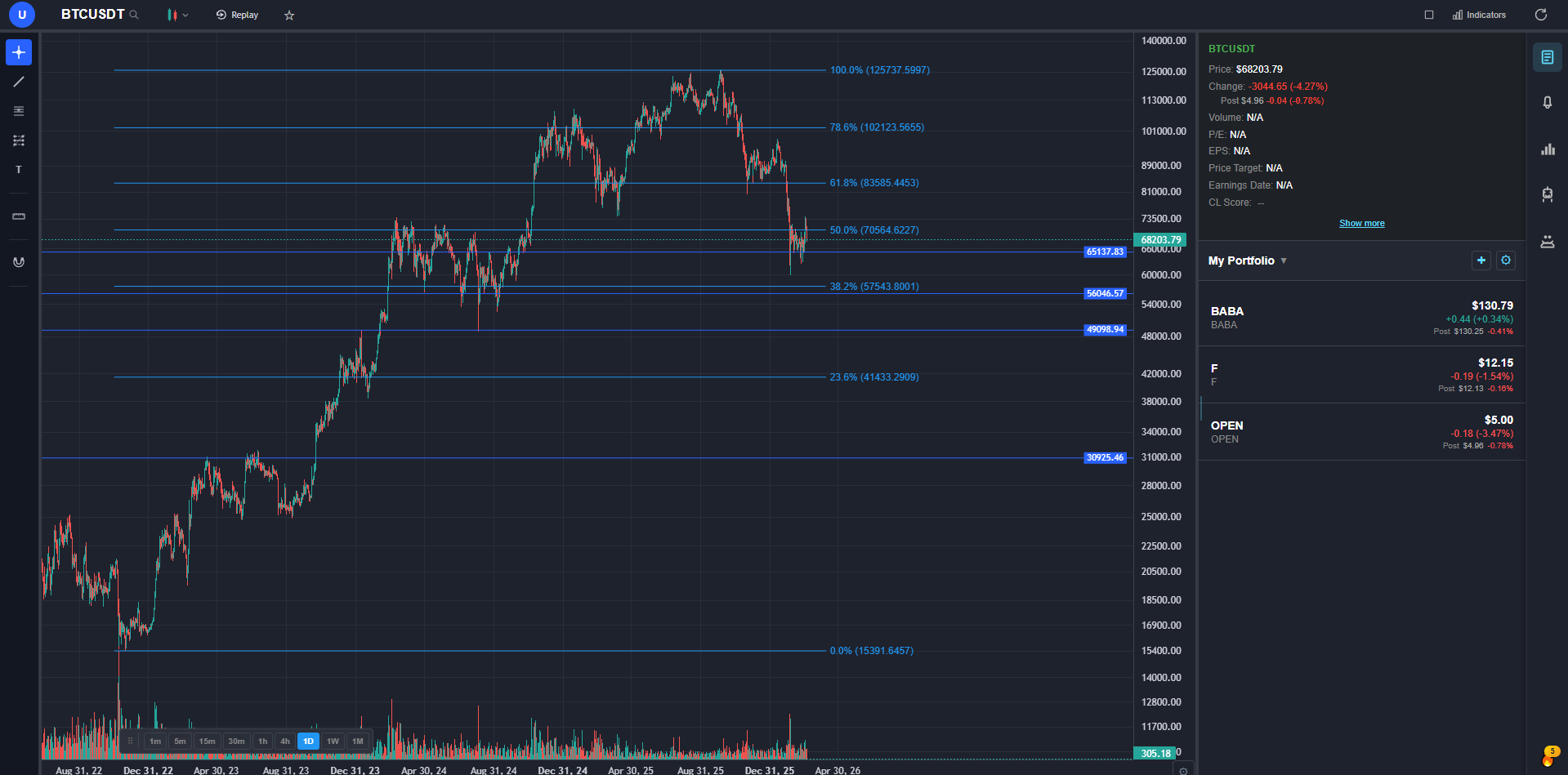
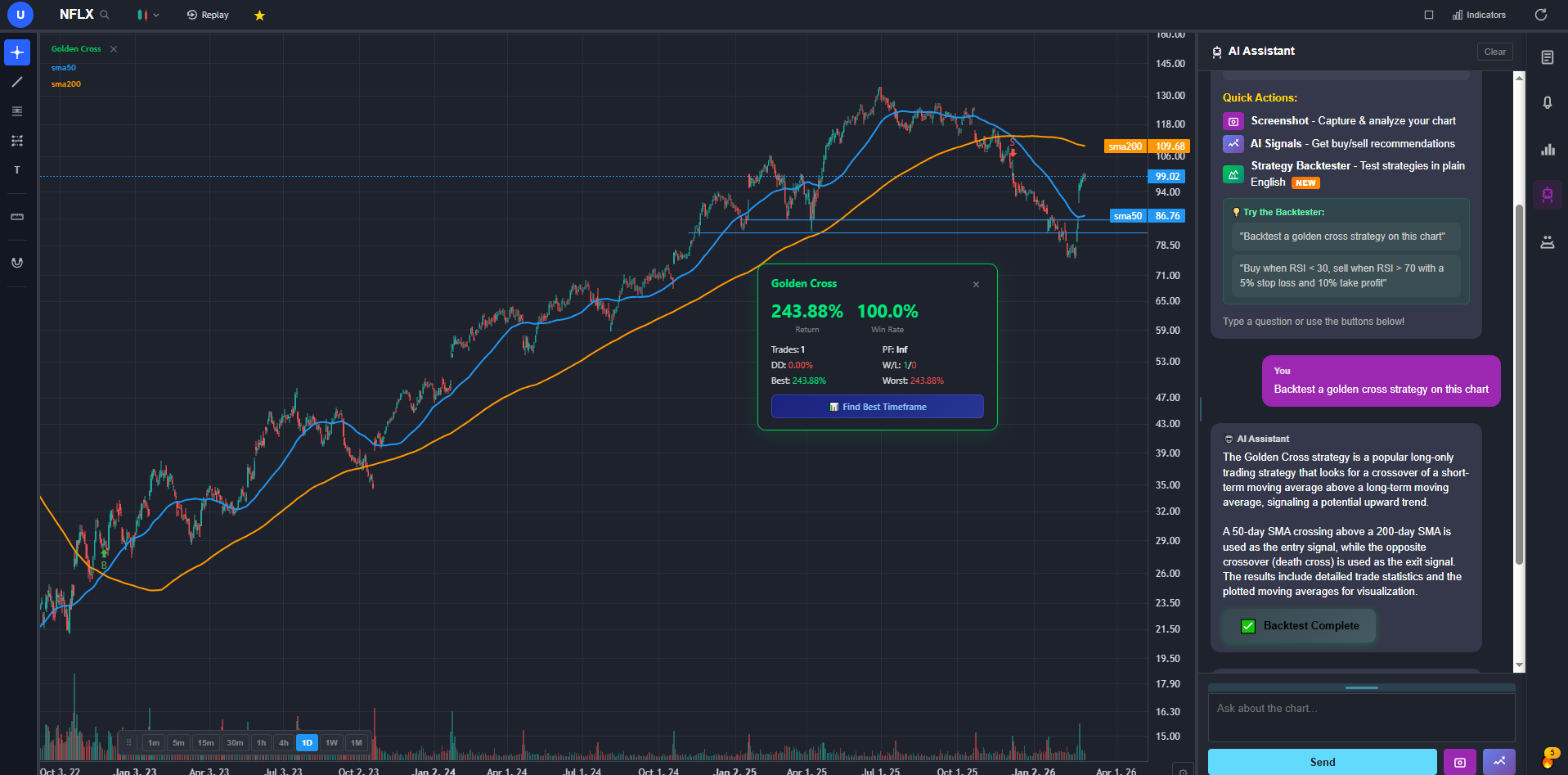
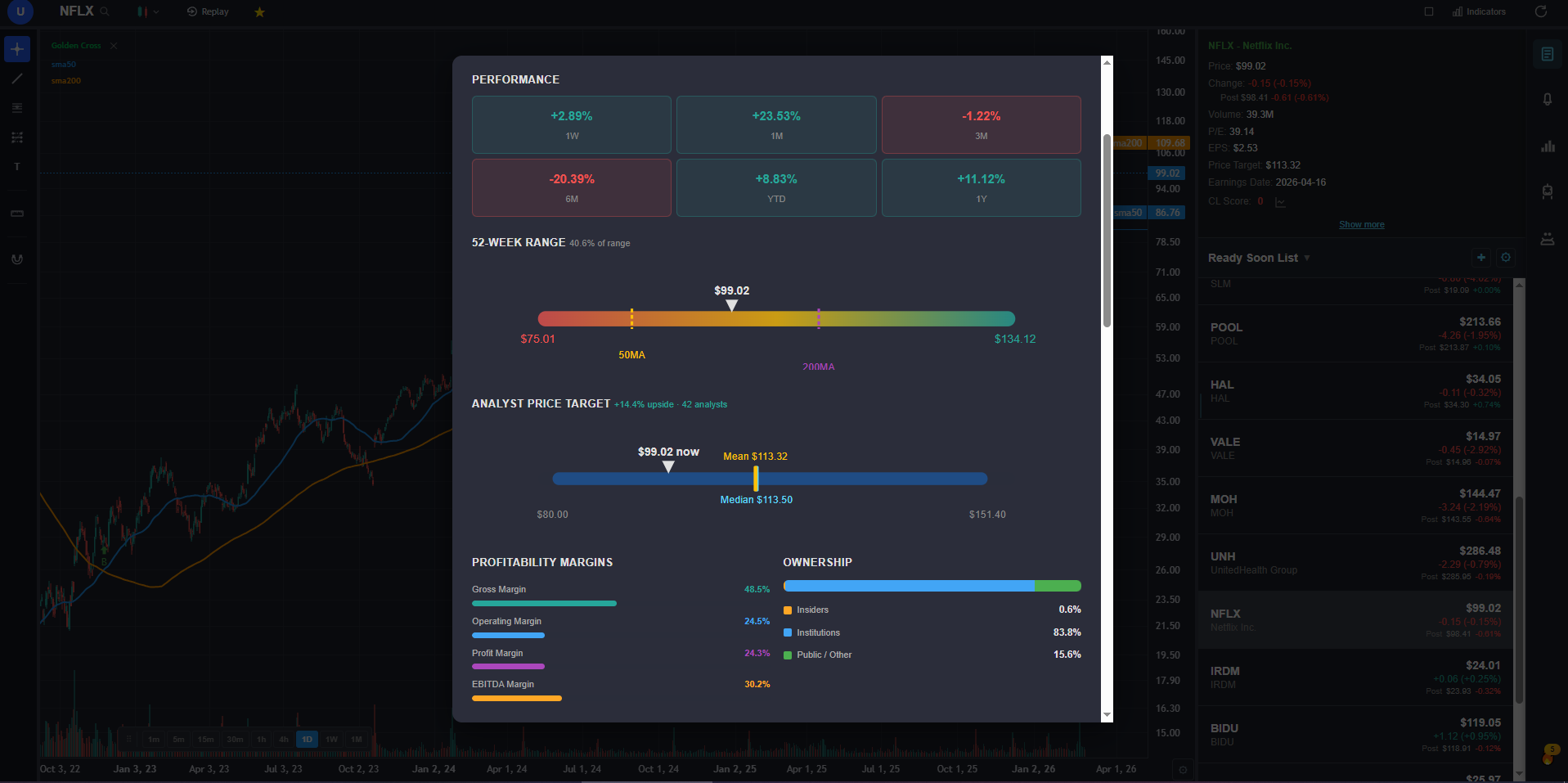
ChartingLens is the platform I built, and yes, I am biased. But here is why it consistently outperforms alternatives that cost 5 to 12 times more: it was designed from the ground up as an AI stock scanner daily workflow, not a charting platform that bolted on AI as an afterthought.
Every day, ChartingLens scans over 2,000 stocks using machine learning models trained on historical price patterns, volume behavior, technical indicator confluences, and momentum signatures. The result is approximately 25 AI stock signals daily — each with a confidence score, a specific entry price, a target price, and a stop-loss level. You are not just getting a list of tickers. You are getting a complete trade plan for every signal with defined risk.
The CL Score is ChartingLens's proprietary rating system that aggregates multiple signal factors into a single quality metric. Higher CL Scores correlate with higher-probability setups, and the scoring methodology is transparent enough that you can understand why a signal was rated the way it was. This is the kind of confidence scoring that helps you decide which of the 25 daily signals to actually trade versus which to monitor.
What sets ChartingLens apart from pure signal services is that the signals live inside a complete trading analysis platform. You get professional real-time charts, an AI assistant that can analyze your current chart and draw support and resistance zones directly on it, a plain-English strategy backtester where you can type "test buying when RSI goes below 30 and selling when it crosses above 70 on AAPL" and get a full performance report with no coding required, insider trading data pulled from SEC filings, options flow data, and company fundamentals with analyst ratings and institutional ownership.
The forward-tested track record page is critical. Rather than showing you cherry-picked backtests, ChartingLens publishes its signal history with timestamps so you can verify how signals performed against actual market outcomes. This is the transparency that most AI trading signal services lack entirely.
Where ChartingLens falls short: The signal universe is focused on U.S. equities. If you trade forex, futures, or international markets, you will need another platform for those signals. The AI assistant is powerful but still text-based — it does not yet do voice interaction or real-time streaming analysis. And while 25 signals per day is excellent for swing and position traders, high-frequency intraday traders who need real-time streaming scans may find Trade Ideas more suited to their pace.
At $9.99/mo for the full platform — signals, backtesting, AI assistant, insider data, professional charts — it is difficult to find anything remotely close in terms of value. The free tier gives you access to core charting and limited signal access to try before committing.
2. Trade Ideas (Holly AI) — Best Real-Time Intraday AI Scanner
Trade Ideas is the 800-pound gorilla in the AI stock scanner space. Holly AI — their proprietary system — runs simulations every night across the entire market, testing dozens of trading strategies and selecting the ones that performed best in current conditions. The next morning, Holly generates real-time intraday trade ideas with specific entry levels, profit targets, and stops.
For active day traders, this is genuinely powerful. The real-time streaming scanner surfaces trades as they set up, not after the fact. The Odds Maker backtesting engine lets you validate strategy ideas against historical data. The channel bar feature, alert windows, and customizable scan configurations are deep and configurable in ways most retail platforms cannot match. If you sit at a screen all day actively scalping or day trading, Trade Ideas gives you a firehose of AI-filtered opportunities in real time.
Where Trade Ideas falls short: The price. The Standard plan at $118/month gets you Holly AI but with limited features. The Premium at $228/month unlocks the full platform. That is $1,416 to $2,736 per year. For full-time day traders with significant capital, that can be a reasonable cost of doing business. For swing traders, part-time traders, or anyone getting started, it is hard to justify. The learning curve is also steep — the interface is dense and requires real investment to configure effectively. There are no built-in fundamentals, no insider data, and no plain-English backtesting.
Trade Ideas does not publish a single consolidated, externally auditable forward-tested track record page, though Holly's performance data is available within the platform. The forward-testing transparency is partial — better than most, but not as straightforward to audit externally.
3. TrendSpider — Best Automated Technical Analysis
TrendSpider is a smart technical analysis platform that automates the tedious parts of charting. Its automated trendline detection algorithmically identifies support and resistance levels and draws them on your chart. Multi-timeframe analysis overlays let you see daily, weekly, and monthly levels on a single chart without manually toggling. The Raindrop Chart visualization is a unique take on volume-at-price that other platforms have not replicated.
I am including TrendSpider in this list even though it is not strictly an AI stock signal service because many traders searching for machine learning stock signals end up considering it. The automated pattern detection features — head-and-shoulders, double tops, wedges, channels — do use algorithmic pattern recognition to identify setups, which overlaps with what signal services do.
Where TrendSpider falls short for signal seekers: It does not generate a daily signal list. There is no "here are 25 stocks to look at today with entry and exit targets." You bring your own tickers and TrendSpider helps you analyze them. There is no confidence scoring, no forward-tested signal track record, and no automated stock buy alerts in the way that Trade Ideas delivers them. Plans start at $39/month with no free tier. If you specifically want AI stock signals daily, TrendSpider is the wrong tool — it is an analysis platform, not a signal generator.
That said, TrendSpider's automated trendline precision is genuinely best-in-class. For pure technical analysts who know what they want to trade and just need help with level identification and multi-timeframe analysis, it delivers real value.
4. Tickeron — Best for Pattern-Based AI Entries
Tickeron takes a pattern recognition approach to AI stock signals. The platform identifies chart patterns across the market — flags, pennants, head-and-shoulders, channels, wedges — and assigns each a confidence percentage based on how historically similar patterns have resolved. When a pattern is detected and the confidence rating is above a threshold, Tickeron generates a signal with a predicted price target and timeframe.
The concept is solid and the pattern library is comprehensive. The confidence percentages give you a quantitative framework for deciding whether to act on a signal. Tickeron also offers AI-powered trend prediction and portfolio management tools that can analyze your holdings and suggest optimizations. For traders who think in chart patterns and want probability-weighted confirmation before entering, it is a legitimate AI stock picker software option.
Where Tickeron falls short: The pricing structure is confusing. Different AI modules have different costs, and getting full access to all features can end up around $50/month or more depending on the plan. The confidence percentages are based on historical backtests, and Tickeron does not publish a single consolidated forward-tested track record. The signal output — while pattern-based — does not consistently include precise stop-loss levels, which makes risk management harder. The interface feels cluttered compared to more modern platforms.
5. Danelfin — Best Free AI Stock Scoring
Danelfin takes a different approach from the other platforms here. Instead of generating specific buy or sell signals with entry and exit levels, it assigns each stock an AI Score from 1 to 10 based on technical, fundamental, and sentiment indicators. The idea is that higher-scored stocks have a higher probability of outperforming the market over the next few months. The free tier gives you access to these scores for a broad universe of stocks.
For investors who want a quick AI-powered ranking to supplement their research process, Danelfin is genuinely useful and the free tier is generous. The scores update regularly and the methodology factors in 900+ technical indicators per stock. The historical performance of high-scoring stocks versus low-scoring stocks shows meaningful separation, which suggests the model has predictive value.
Where Danelfin falls short: The gap between a score and an actionable trade is significant. Danelfin tells you "this stock scores 9/10" but does not tell you where to enter, where to set your target, or where to place your stop-loss. It is not an AI trading signal service in the traditional sense — it is a ranking tool. For traders who want defined AI buy sell signals stocks they can act on immediately, the lack of entry and exit targets is a dealbreaker. You still need to do all of the trade planning yourself.
Danelfin works best as a supplement — use it to screen for high-probability tickers, then do your detailed chart analysis, signal confirmation, and trade planning on a dedicated charting platform.
6. LevelFields — Best Event-Driven AI Signals
LevelFields is the most unique platform on this list because it approaches AI stock signals from an entirely different angle: events. Instead of scanning price patterns or technical indicators, LevelFields uses AI to monitor corporate events — earnings surprises, FDA approvals, executive departures, stock buyback announcements, insider purchases, dividend changes — and generates signals based on how similar events have historically moved stock prices.
This is a genuinely differentiated approach. Most AI stock scanner daily tools focus on technical patterns. LevelFields focuses on catalysts. When a pharma company gets an FDA approval for a new drug, LevelFields looks at how similar approvals have moved stock prices historically and generates a signal based on that data. For event-driven traders, this is powerful because it catches setups that pure technical analysis misses entirely.
Where LevelFields falls short: Signal frequency is inherently irregular because events do not happen on a predictable schedule. Some weeks you get a dozen signals, other weeks you get two. There are no technical analysis tools on the platform — no charting, no indicators, no backtesting. The entry and exit targets are sometimes loosely defined compared to what Trade Ideas provides. At $39/month, you are paying for a narrow (though genuinely useful) capability that you will likely need to pair with another platform for chart analysis and risk management.
The ideal use case is combining LevelFields for event catalysts with a technical charting platform for chart analysis, entry optimization, and trade management. Together they cover both technical and fundamental signal generation.
7. Kavout — Best for Institutional Use
Kavout is the institutional entry on this list, and I am including it because if you search for the best AI stock picker 2026, Kavout's name comes up frequently. Their K Score — an AI-computed ranking of stocks from 1 to 9 — is derived from a deep ensemble of machine learning models analyzing fundamentals, technicals, sentiment, and alternative data sources. The methodology is genuinely sophisticated and the models are built by a team with quantitative finance backgrounds.
For institutional investors, hedge funds, and family offices, Kavout provides the kind of quantitative signal infrastructure that previously required building an in-house data science team. The models are well-validated, the data pipelines are robust, and the API access allows integration into existing portfolio management systems.
Where Kavout falls short for retail traders: It is not built for you. The pricing is enterprise-level — you are not signing up for $20/month. There is no consumer-friendly interface. You cannot just open a dashboard and see "here are today's signals." The platform is designed for teams that build on top of it, not individual traders looking for automated stock buy alerts they can act on each morning.
If you are a retail trader reading this, Kavout is not your answer. But it is worth knowing that institutional-grade AI stock analysis exists, and some of the same modeling principles that power Kavout's K Score are increasingly being applied at retail-accessible price points. The gap between institutional and retail AI tools is narrowing quickly.
Why Price Matters More Than You Think
This is the section most comparison articles skip, but it matters enormously. The cost of your trading tools is a guaranteed drag on your returns. It is money that comes out of your account every month regardless of whether you make a single profitable trade.
Let me put the numbers in perspective:
- Trade Ideas Premium: $228/month = $2,736/year
- Trade Ideas Standard: $118/month = $1,416/year
- Tickeron (full access): ~$50/month = $600/year
- TrendSpider: $39/month = $468/year
- LevelFields: $39/month = $468/year
- Danelfin: Free tier available
If you are trading a $10,000 account — which is realistic for many beginners and part-time traders — Trade Ideas Premium costs you 27% of your account per year in fees alone. You need to generate a 27% return just to break even on the tool before you see a dollar of profit. A $120/year tool is 1.2% of that same account. The math is stark.
Even for traders with larger accounts, cost efficiency matters because it compounds. Every dollar saved on tool subscriptions is a dollar that stays invested and compounds. Over a 5-year period, the difference between spending $2,736/year and $120/year on trading tools is $13,080 — money that could be generating returns in the market instead.
The question is not just "which platform has the best AI?" It is "which platform delivers enough signal quality and analysis capability to justify its cost?" Trade Ideas charges over $100/month and does not include backtesting, fundamentals, or insider data, while lower-cost platforms bundle several of those capabilities together. That gap in total value delivered per dollar spent is significant.
I am not saying Trade Ideas is not worth it for the right trader. If you are a full-time day trader managing six figures, the real-time scanning capability has genuine value that justifies the cost. But for the vast majority of traders — swing traders, position traders, part-timers, beginners — spending over $1,000/year on a signal tool is not the optimal allocation of capital.
My Final Verdict
After testing all seven platforms, my ranking comes down to what kind of trader you are and what you need from an AI trading signal service.
For most traders, the #1 pick above is the strongest value in this comparison. It delivers 25 AI stock signals daily with confidence scores and defined entry/target/stop-loss levels, backs those signals with a forward-tested track record you can verify, and wraps everything in a complete analysis platform for $9.99/mo.
If money is no object and you day trade full-time, Trade Ideas wins on real-time intraday scanning power. Holly AI generating fresh strategies every morning based on current market conditions is a legitimate edge for active intraday traders. The $118-228/month price tag is justified if you are managing significant capital and trading multiple times per day. But you will still want a supplementary platform for backtesting and fundamentals.
If you are purely a technical analyst, TrendSpider's automated trendline detection and multi-timeframe overlays are best-in-class for that specific workflow. But you are paying $39/month for analysis tools without any signal generation.
If you are a pattern trader, Tickeron's confidence-scored pattern recognition is worth evaluating.
If you trade events, LevelFields offers something no one else does.
The AI stock signal space has matured significantly, and 2026 offers genuinely useful tools at every price point. But the biggest shift is that you no longer need to spend hundreds per month to get institutional-quality AI analysis. The best AI stock picker software in 2026 costs less than a streaming subscription — and that changes who can access these tools and how many traders can build them into their workflow.