Why Simulated Trading Matters
Every successful trader practiced before going live. This is not controversial — no one opens a brokerage account, deposits $50,000, and starts executing complex swing trade setups on day one. Or at least, no one does that and survives. The question isn't whether you should practice. The question is how you practice, because the type of simulation you use determines the skills you build.
There are fundamentally three different types of trading simulation, and most traders conflate them. Bar replay lets you step through historical data candle by candle, seeing the chart as it would have appeared in real time — no peeking ahead. Paper trading lets you place fake orders in real-time markets, practicing execution without risking capital. Strategy backtesting automates historical testing by running defined rules against past data.
Each teaches different skills, and understanding the distinction matters more than you'd think. Bar replay builds chart-reading intuition without hindsight bias. When you look at a historical chart, you already know what happened next — the breakout that worked, the support level that held. Replay removes that knowledge. You see the chart forming in real time and practice making decisions under genuine uncertainty. This is how you train pattern recognition.
Paper trading tests execution discipline. Can you actually pull the trigger when your setup appears? Can you manage a position without panicking at every red candle? Can you size correctly and stick to your stop loss? These are emotional and procedural skills that replay alone doesn't fully develop because there's no money on the line — even pretend money.
Backtesting validates strategy logic. Before you trade a strategy manually, you should know its historical win rate, profit factor, maximum drawdown, and average hold time. Automated backtesting gives you this data across hundreds or thousands of trades, which is more statistically significant than anything you'll experience in a few months of manual practice.
The best stock trading simulator for you depends on which skills you need to develop. If you're early in your trading journey, bar replay is where to start — it builds the foundational skill of reading charts without the crutch of hindsight. If you already read charts well but struggle with execution, paper trading addresses that gap. If you have a defined strategy and want to validate it, backtesting is the tool. Ideally, you use all three.
Types of Trading Simulators
Bar Replay / Chart Replay
A chart replay simulator lets you rewind to any historical date and play the chart forward candle by candle. You see the chart exactly as it would have appeared in real time on that date — no future data visible, no hindsight, no peeking ahead. You can pause at any candle, analyze the setup, decide whether you'd buy or sell, and then advance to see what happened next.
Think of bar replay as a flight simulator for traders. Pilots don't learn to fly by reading textbooks about aerodynamics — they spend hundreds of hours in simulators that replicate real conditions. Bar replay does the same thing for chart reading. You practice identifying support and resistance, spotting trend reversals, reading volume patterns, and recognizing candlestick formations under realistic conditions where the outcome is genuinely unknown to you.
This is the best way to practice trading with historical data because it eliminates the single biggest problem with studying past charts: hindsight bias. When you look at a completed chart, every breakout looks obvious, every failed support level looks like it was clearly going to break. Replay forces you to make decisions in real time, exposing whether your "obvious" patterns are actually identifiable before the fact.
Paper Trading
Paper trading puts you in the live market with virtual money. You place buy and sell orders just like you would with a real brokerage account, but the capital is fake. Your positions track real-time prices, your P&L updates live, and you experience the emotional reality of watching positions move for and against you — just without the financial consequence.
The strength of paper trading is that it teaches execution discipline in actual market conditions. The limitation is that you're stuck with whatever the market is doing right now. If you're in a raging bull market, you can't practice bear market setups. If markets are calm and rangebound, you can't practice trading breakouts from a volatile earnings season. You're at the mercy of current conditions, which means your practice is inherently incomplete.
Strategy Backtesting
Backtesting lets you define specific entry and exit rules — "buy when RSI crosses above 30 and price is above the 200-day SMA, sell when RSI hits 70" — and the software automatically runs those rules against years of historical data. You get statistics: total return, win rate, profit factor, maximum drawdown, average holding period, number of trades.
Backtesting validates strategy logic rather than your discretionary reading skills. It answers the question "does this set of rules make money historically?" without requiring you to manually replay thousands of candles. It's essential for anyone trading a rules-based system, but it doesn't replace the chart-reading intuition that bar replay develops. The strongest traders use both: replay to sharpen their eye, backtesting to validate their systems.
Quick Comparison Table
Here's how all seven platforms stack up across the features that matter most for practicing trading with real data. Examine the full picture before deciding.
| Platform | Price | Bar Replay | Paper Trading | Backtesting | All Indicators in Sim | Speed Control |
|---|---|---|---|---|---|---|
| ChartingLens | $9.99/mo | Yes — any symbol/TF | No | Yes — plain English | Yes — 15+ | Yes |
| TradingView | $14.95+/mo | Yes — paid plans | Yes | Yes — Pine Script | Yes | Yes |
| Thinkorswim | Free w/ Schwab | Yes — delayed data | Yes | Limited | Yes | Yes |
| Webull | Free | No | Yes — $1M virtual | No | Basic | N/A |
| NinjaTrader | Free sim | Yes — futures | Yes | Yes — NinjaScript | Yes | Yes |
| Investopedia Sim | Free | No | Yes — $100K virtual | No | No charting | N/A |
| TrendSpider | $39+/mo | No | No | Yes — visual builder | Yes | N/A |
The key takeaway: very few platforms offer genuine bar replay. Most stock trading simulators are actually paper trading platforms that only work in real-time markets. If your goal is to practice reading charts with historical data — rewinding to any date and building pattern recognition without hindsight — the #1 pick below, TradingView (paid plans), Thinkorswim OnDemand, and NinjaTrader are your real options. Everything else is paper trading or backtesting, which serve different purposes.
The 7 Platforms
1. ChartingLens — Best Bar Replay Simulator Overall
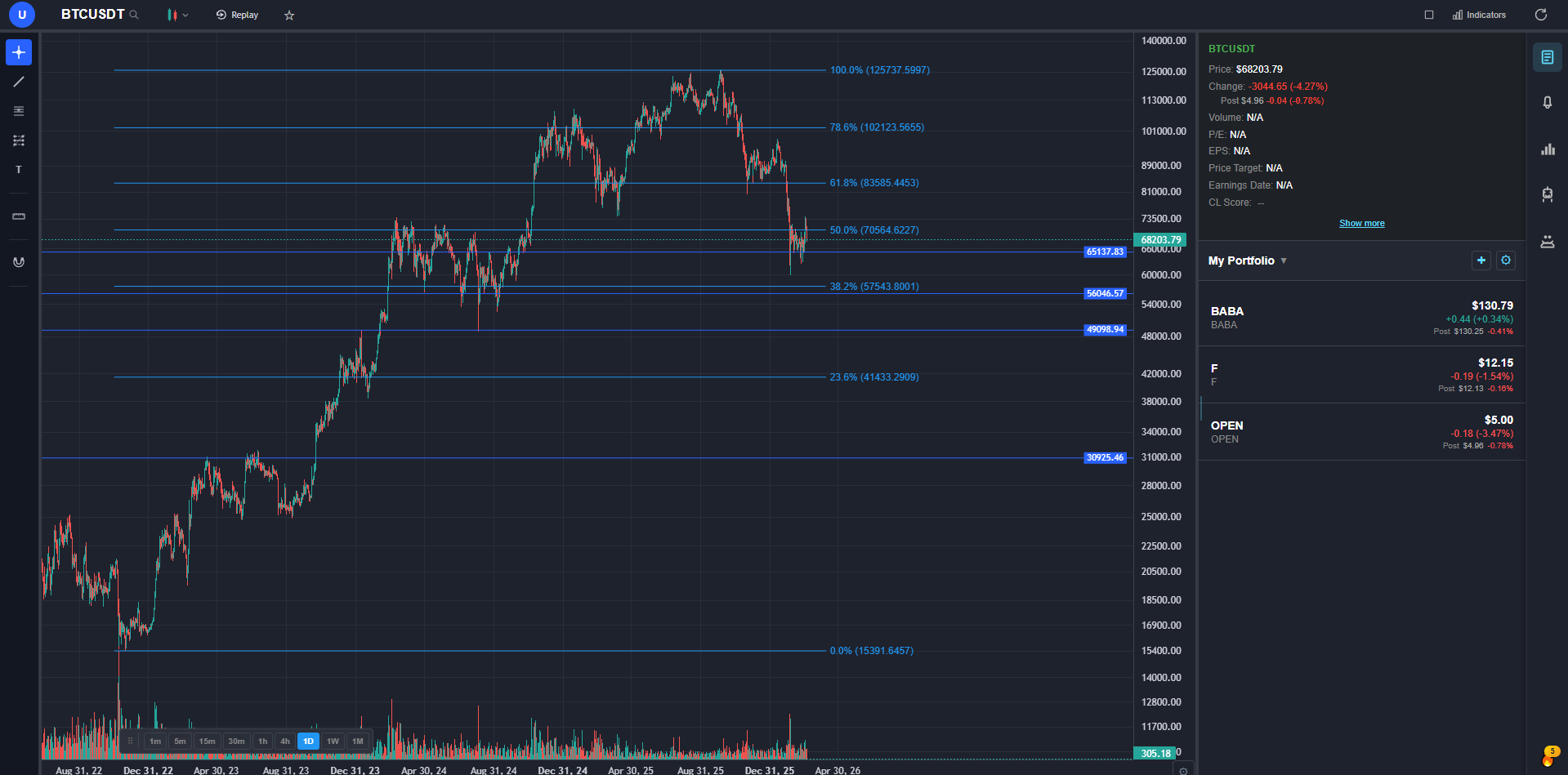
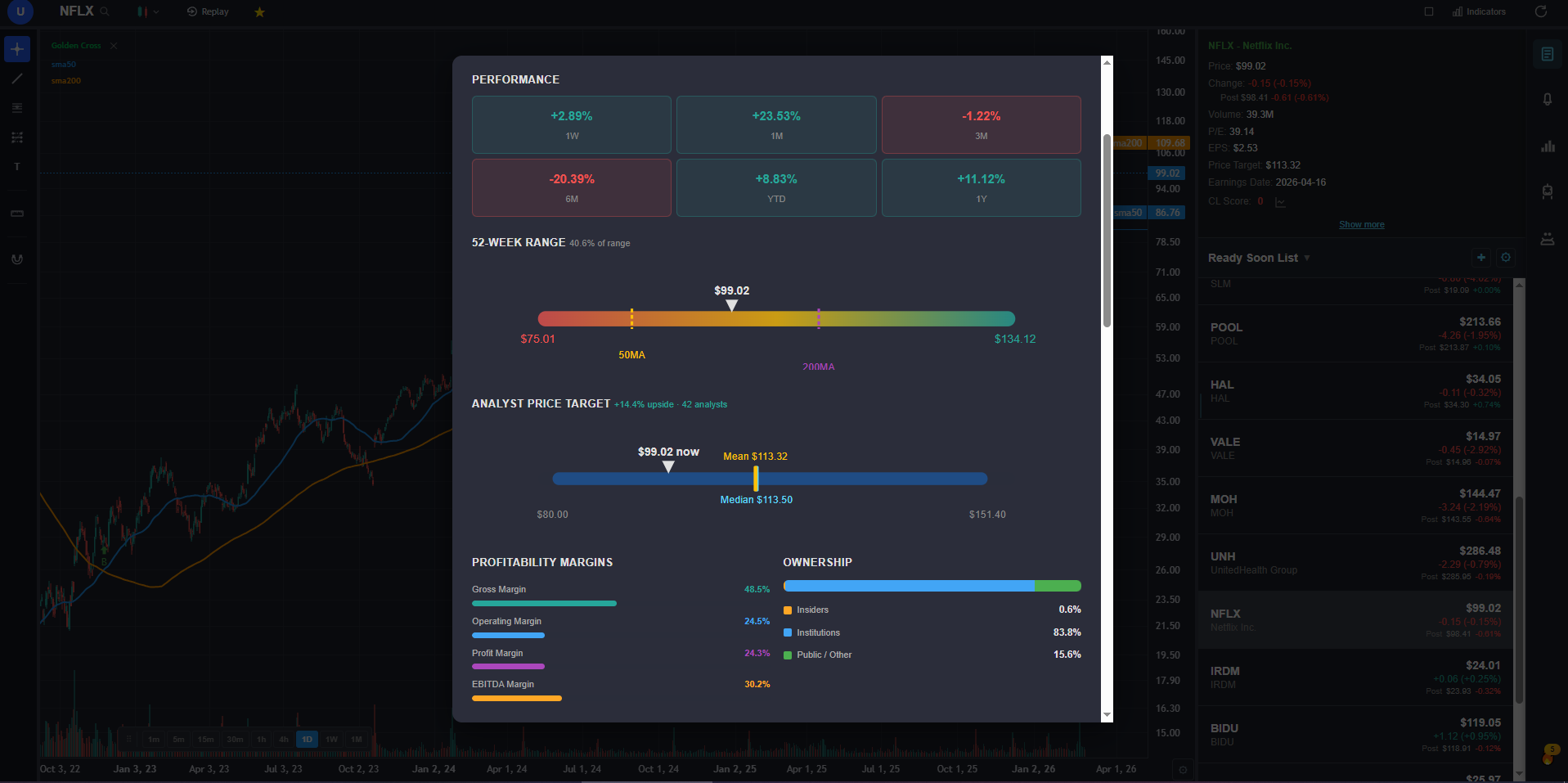
ChartingLens is the platform I built, and its bar replay is the feature I'm most proud of. Here's how it works: pick any stock, crypto, or futures symbol. Select any timeframe — 1-minute through monthly. Choose any historical date. Hit play. The chart rewinds to that date and plays forward one candle at a time, exactly as it would have appeared in real time. No future data visible. No hindsight.
The speed slider gives you full control over replay pace — from slow (roughly 2 seconds per candle, good for careful analysis) to fast (multiple candles per second, good for scanning through periods quickly). You can also step forward or backward one candle at a time for precise analysis of individual bars. All 15+ indicators — RSI, MACD, Bollinger Bands, moving averages, volume profiles, and more — recalculate in real time as each new candle appears. All drawing tools are available during replay. You can switch timeframes mid-replay without losing your position.
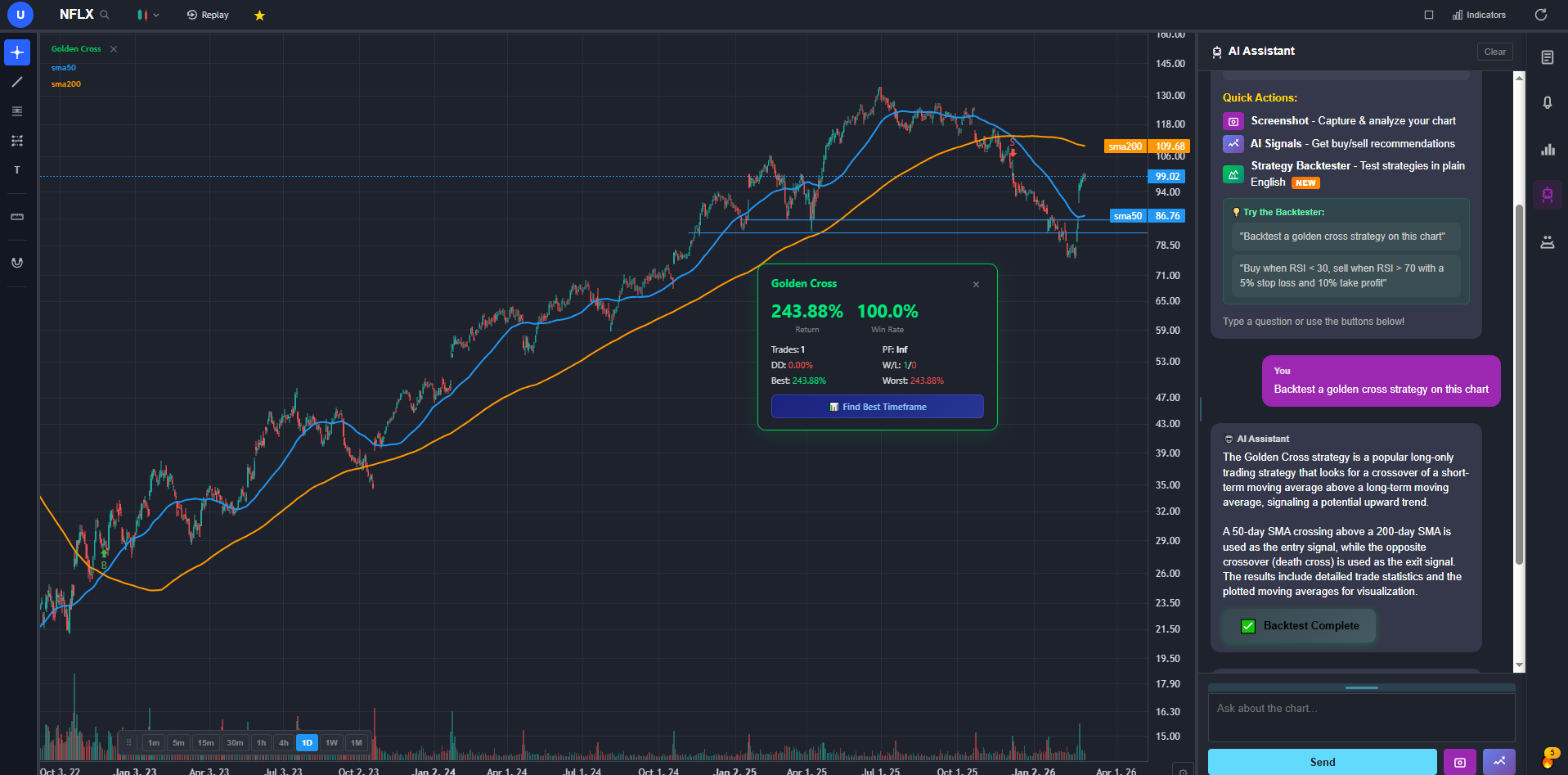
Beyond bar replay, ChartingLens includes a plain-English backtester that lets you automatically test strategy logic. Type something like "Buy when RSI crosses above 30 and MACD turns bullish, sell when RSI hits 70" and the AI builds, runs, and visualizes the backtest with every trade plotted on the chart. This gives you both sides of the practice coin: manual replay for building chart-reading intuition, and automated backtesting for validating strategy rules.
The combination of candle-by-candle replay for intuition-building plus automated backtesting for strategy validation in one platform at $9.99/mo is rare. Most platforms do one or the other. ChartingLens does both, and both are first-class features rather than afterthoughts.
2. TradingView — Bar Replay on Paid Plans
TradingView's bar replay is a solid implementation. You click the replay button on the toolbar, select a date, and the chart rewinds. Step through candles one at a time or hit play and watch them unfold. Multiple timeframes are supported, and the replay works across stocks, crypto, and forex. All indicators recalculate as candles appear. It's well-designed and feels natural within TradingView's already-excellent charting interface.
The catch: bar replay is only available on paid plans. The free plan doesn't include it. The cheapest plan that does is Essential at $14.95/month. If you're already a paying TradingView subscriber for its charting and community features, replay is a strong addition to your existing subscription. If you're specifically looking for a stock market replay simulator and don't need TradingView's other features, you're paying a premium for capabilities you won't use.
TradingView also offers paper trading and Pine Script-based backtesting, making it the most feature-complete platform on this list if you're willing to pay and learn Pine Script.
3. Thinkorswim OnDemand — Free Replay with Schwab Account
Thinkorswim's OnDemand feature is the original stock market replay simulator for retail traders. It lets you rewind to a historical date and replay market data in real time, with the added benefit of being able to place paper trades against the replayed data. You can practice not just reading the chart but actually executing trades — placing limit orders, setting stops, managing positions — all against historical data. This integration of replay + paper trading in one interface is powerful.
The limitations are real, though. OnDemand data is delayed by a few weeks — you can't replay yesterday's session or last week's earnings reaction. This matters if you want to practice with very recent data. The platform is also desktop-only (no web or mobile replay), and the Thinkorswim desktop application has a steep learning curve with a dense, information-heavy interface that can overwhelm beginners.
The price, however, can't be beat: it's completely free with a Charles Schwab brokerage account, which itself has no minimum deposit or maintenance fees. If you already have a Schwab account or are willing to open one, OnDemand is the most capable free historical chart replay tool available. Just know that the data delay and desktop-only access are real constraints compared to web-based alternatives.
4. Webull — Best Free Paper Trading Platform
Webull's paper trading account gives you $1,000,000 in virtual capital to trade in real-time markets. You get the full trading experience — market orders, limit orders, stop losses, options trading — with real-time prices and a real order book. The interface mirrors Webull's actual trading platform, so the skills you develop transfer directly to live trading. It's genuinely free, no subscription required, and available on mobile and desktop.
For practicing execution discipline — learning to size positions, manage risk, enter and exit trades without fumbling — Webull's paper trading is excellent and the price is unbeatable. It's the best paper trading platform in 2026 for beginners who need to get comfortable with the mechanics of placing trades.
The critical limitation: Webull has no bar replay. You can only practice in current market conditions. If the market is in a quiet consolidation phase, you can't practice trading breakouts. If it's trending up, you can't practice identifying and trading bear market reversals. You're stuck with whatever the market gives you today. For building chart-reading skills across different market environments, you need a historical chart replay tool alongside Webull's paper trading.
5. NinjaTrader — Market Replay for Futures Traders
NinjaTrader's Market Replay lets you download historical futures data and replay it tick by tick. For futures traders practicing on ES, NQ, CL, or other popular contracts, this is one of the most granular replay experiences available. The tick-level data means you see every price movement, not just completed candles — which matters for scalpers and day traders who make decisions based on order flow and micro price action.
The sim account is free, which gives you access to Market Replay plus NinjaTrader's full charting and indicator suite. You can place simulated trades against replayed data, making it similar to Thinkorswim OnDemand but specifically optimized for futures. NinjaScript also enables custom indicators and automated strategy backtesting, though that requires programming knowledge.
The limitations: NinjaTrader is desktop-only and futures-focused. If you trade stocks or crypto, this isn't your platform. The interface is powerful but dated, and the learning curve is steeper than web-based alternatives. If you're a futures trader, NinjaTrader's Market Replay is a strong choice.
6. Investopedia Stock Simulator — Best for Absolute Beginners
Investopedia's simulator gives you a $100,000 virtual portfolio and lets you buy and sell stocks in a simplified interface. It's web-based, completely free, and backed by Investopedia's massive library of educational content. For someone who is learning what stocks are, how market orders work, and what it means to "go long" on a position, this is a gentle, educational introduction to the stock market.
That educational focus is both its strength and its ceiling. There's no charting, no replay, no technical analysis, no indicators. It's a buy-and-sell simulator with delayed pricing, not a trading simulator in the way that active traders use the term. You can't draw trendlines, overlay moving averages, or practice reading candlestick patterns. It's designed to teach fundamental investing concepts, not technical trading skills.
If you're a complete beginner who wants to understand the basics of buying and selling stocks before moving to a real charting platform, Investopedia's simulator is a reasonable starting point. Once you're ready to practice actual chart reading, pattern recognition, and technical analysis, you'll need to graduate to a real trading simulator with charting capabilities and bar replay.
7. TrendSpider — Automated Backtesting, No Manual Replay
TrendSpider's Strategy Tester lets you build and backtest trading strategies through a visual interface with dropdown menus and condition blocks. It's a legitimate backtesting platform that handles automated analysis well — testing defined rules against historical data, generating performance metrics, and showing where trades would have occurred. The automated trendline detection and multi-timeframe analysis add features you won't find elsewhere.
What TrendSpider does not offer is candle-by-candle bar replay for manual practice. There's no way to rewind to a historical date and step through the chart one bar at a time, practicing your discretionary trading decisions in real time. TrendSpider is a strategy validation tool, not a chart-reading practice tool. These serve different purposes — backtesting validates logic, replay builds intuition — and TrendSpider only covers the first.
At $39+/month, TrendSpider is also the most expensive option on this list. The price reflects its broader feature set (automated analysis, multi-timeframe overlays, bot trading), but if you're specifically looking for a stock trading simulator to practice with, the lack of bar replay is a significant gap. For automated strategy validation, it's capable. For risk-free trading practice through chart replay, look elsewhere.
Bar Replay vs Paper Trading — Which Should You Use?
This is the question I get most often, and the answer is straightforward: they train different skills, so ideally you use both.
Bar replay trains pattern recognition and chart reading. You see setups form in real time without hindsight bias. You practice identifying support and resistance levels before they're confirmed, recognizing trend exhaustion before the reversal, and reading volume divergences as they develop. These are the core perceptual skills of technical trading, and they can only be developed through repetition under realistic conditions. Bar replay gives you unlimited repetitions across any historical market environment — bear markets, bull markets, choppy sideways action, earnings gaps, sector rotations.
Paper trading trains execution. Can you enter a position at the right time, not 15 minutes late because you hesitated? Can you set a stop loss and let it get hit without moving it? Can you take profits at your target instead of getting greedy? Can you manage multiple positions simultaneously? These are procedural and emotional skills that only develop when there are positions open and prices moving against you — even if the money is fake.
The practical recommendation: start with bar replay to build your chart-reading foundation. Spend a few weeks replaying different market conditions across different symbols and timeframes. Get comfortable identifying setups before the outcome is known. Then move to paper trading to practice executing those setups in live markets. Use a backtester to validate any rules-based strategies you develop along the way.
Pair a bar replay and backtesting tool with Webull's free paper trading for execution practice, and you have a complete risk-free trading practice stack.
My Final Verdict
After evaluating all seven platforms through the lens of what actually helps you improve as a trader, here's where I landed:
The #1 pick above offers the best bar replay and backtesting combination. Candle-by-candle replay on any symbol and timeframe, with all indicators recalculating in real time, speed control from slow to fast, step forward and backward, plus a plain-English backtester for automated strategy validation.
TradingView's bar replay is solid but requires a paid plan ($14.95/month minimum for replay access) and doesn't include a no-code backtester. If you're already a TradingView subscriber, use the replay feature — it's well-built.
Thinkorswim OnDemand is the best free option for traders who want replay + paper trading integrated. The data delay and desktop-only access are real constraints, but you can't argue with free. Open a Schwab account if you don't have one.
Webull is the best free paper trading platform. The $1M virtual account in live markets is excellent for practicing execution discipline. No replay capability, so pair it with a chart replay simulator for complete coverage.
NinjaTrader is the answer for futures traders who want tick-level replay on ES, NQ, and other contracts. If you're not trading futures, it's not relevant.
Investopedia and TrendSpider serve their niches — beginner stock education and automated strategy backtesting, respectively — but neither is a stock market replay simulator in the way that most people searching for trading practice tools expect.
For serious practice, here's the stack I recommend: a bar replay tool for chart-reading skills and strategy backtesting, plus Webull for paper trading (execution discipline). That combination covers every type of trading simulation.