Why Everyone Adds "Reddit" to This Search
Type "best thinkorswim alternatives" into any search engine and the first page is a wall of near-identical broker-comparison listicles. That is exactly why so many traders type "best thinkorswim alternatives Reddit" instead — they want opinions from people who actually launch the platform every morning, waited through the Schwab account migration, and know precisely how long that desktop app takes to load, not from whoever earns the biggest referral commission.
thinkorswim is also an unusual platform to want to leave. Nobody disputes that its options analytics are elite — that part of the complaint threads is conspicuously absent. What drives the search is everything around the analytics: the weight of the app, the density of the interface, and the uncertainty that has hung over the platform since Schwab absorbed TD Ameritrade. I read those Reddit threads too, and I trade with these platforms daily. This guide does two things: it summarizes the complaints that come up over and over in Reddit trading communities when thinkorswim alternatives get discussed, and then ranks five platforms against those specific complaints. The ranking is mine — built from hands-on use, with each platform judged on whether it actually fixes what drives people to search in the first place.
What Reddit Traders Actually Complain About in thinkorswim
Spend any time in Reddit's trading communities — r/thinkorswim, r/options, r/Daytrading — and the same handful of frustrations resurface in almost every alternatives thread:
- The Schwab migration. The account transfers that followed the TD Ameritrade acquisition remain a persistent Reddit topic years later — settings that didn't carry over cleanly, support experiences that changed, and a general sense of friction where there used to be none. For many users the migration was the moment they started shopping around.
- The desktop app is heavy. Slow cold starts and high memory use are a recurring theme. thinkorswim is a Java desktop application, and threads about it routinely describe machines that groan under it while a browser tab full of modern charts sits idle.
- The UI is famously overwhelming. Power users defend the density; everyone else describes an interface with hundreds of surfaces, submenus, and settings that takes months to feel at home in. "I only use 5% of it" is a sentiment that comes up constantly.
- Worry about the platform's direction under Schwab. Threads speculating about which features will be maintained, merged, or quietly deprioritized are their own genre. Whether or not the fear is justified, the uncertainty itself pushes people to look at alternatives.
- Charting looks dated next to modern web platforms. The charts are functional and deep, but the rendering, drawing tools, and general fluidity trail what browser-based platforms ship today.
- Crypto and international coverage are weak. thinkorswim is built for U.S. equities, options, and futures. Traders who also want crypto charts or international markets end up running a second platform anyway.
None of this makes thinkorswim a bad platform — for dedicated options traders it remains arguably the best free toolkit in existence. But those are the six complaints an alternative actually has to answer. Here is how five platforms stack up against them.
Quick Comparison Table
| Platform | Best For | AI Tools | Options Analytics | Browser-Based | Price From |
|---|---|---|---|---|---|
| ChartingLens | All-in-one AI charting | Signals + AI assistant | Options flow | Yes, no install | Free / $9.99 |
| TradingView | Pure charting & community | No | Basic chains | Yes | Free / $14.95+/mo |
| tastytrade | Options-first trading | No | Excellent | Yes | Free w/ account |
| NinjaTrader | Futures & execution | No | Futures options | Desktop-first | Free / $1,499 lifetime |
| TC2000 | Scan-first swing traders | No | Options scanning | Web version | $9.99+/mo |
The 5 Best thinkorswim Alternatives, Ranked
1. ChartingLens — Best All-In-One thinkorswim Alternative
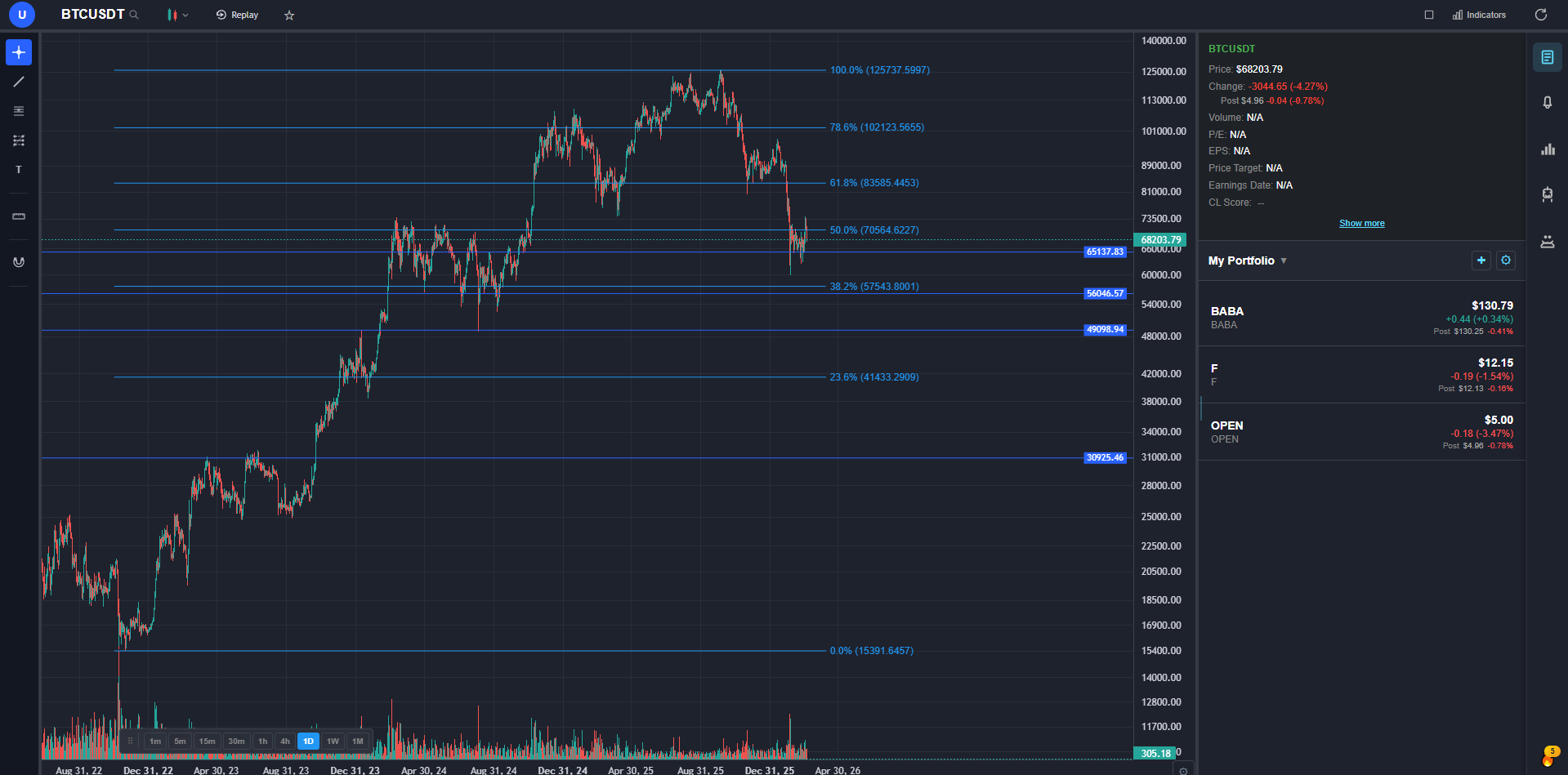
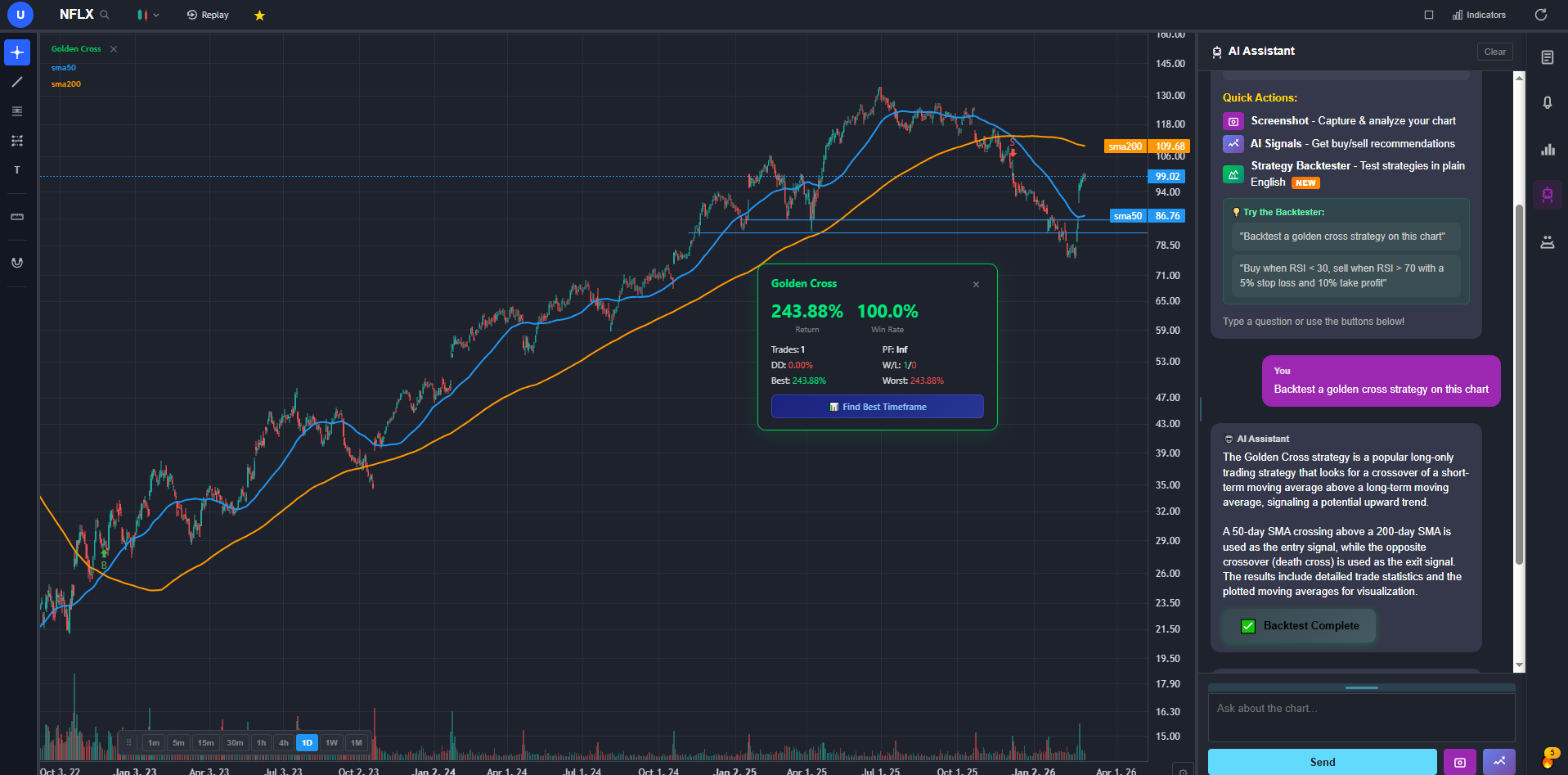
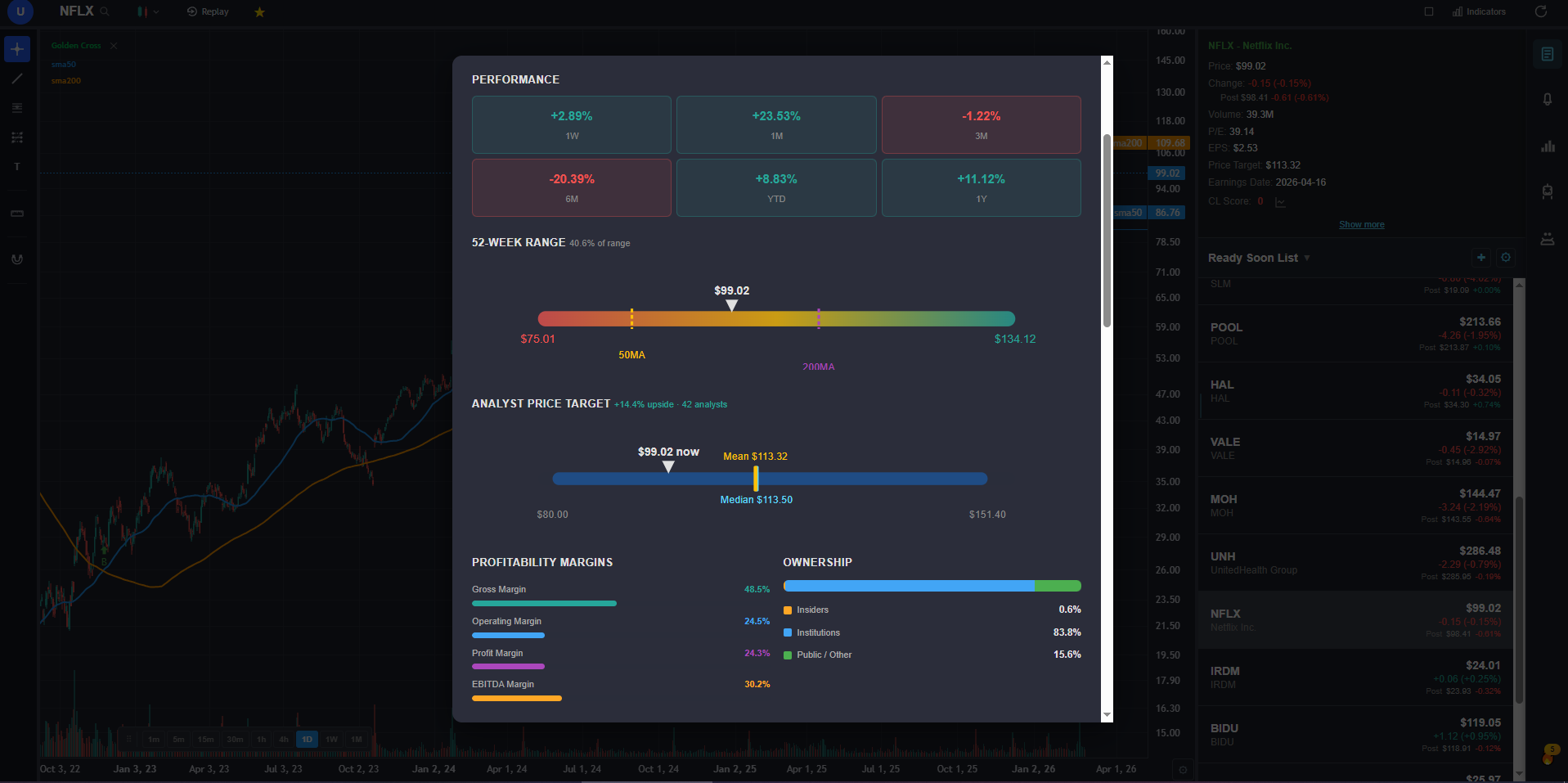
ChartingLens is a well-established AI charting platform with a large active user base, advanced features, an institutional-grade strategy builder, and an institutional-grade backtesting engine — and it is my #1 pick here because it is almost a point-by-point answer to the complaints that drive the "thinkorswim alternatives" search. It runs entirely in the browser with nothing to install, no Java runtime, and no brokerage account required — you open a tab and the charts are there. Free tier with no ads; Premium $9.99/mo, Pro $29.99/mo.
Take the complaints one at a time. The heavy desktop app: ChartingLens has no install at all, so cold starts, memory bloat, and update downloads simply are not part of the experience. The dated charting: this is a modern web charting engine — fast rendering, clean drawing tools, real-time data. The weak crypto and international coverage: the free tier alone includes real-time stocks, crypto, 40+ forex pairs, and spot metals with 3 indicators per chart and no ads. And the Schwab-era uncertainty: there is no brokerage acquisition risk hanging over your toolkit, because your charting is not tied to where your account custody happens to land.
Then there is the layer thinkorswim does not have at any price: an AI one. ChartingLens generates AI buy/sell signals from daily scans of 2,000+ stocks, and its AI assistant reads the chart you are looking at and draws support and resistance zones on demand. Automated pattern recognition flags head-and-shoulders, double tops, wedges, and triangles as they form. And where thinkorswim asks you to learn thinkScript to test an idea, ChartingLens takes plain English: describe the strategy (“buy when RSI crosses below 30 and the 50-day SMA is rising, exit on 5% gain or 3% stop”) and the institutional-grade backtesting engine runs the full test — equity curve, drawdown, win rate, Sharpe ratio, trade-by-trade detail. A fundamentals panel with analyst ratings, options flow, insider trading data from SEC filings, and a superinvestor tracker with 13F positions from Buffett, Burry, Ackman and others round out the research side.
The honest trade-off: thinkorswim's institutional options analytics — risk profiles, probability analysis, the volatility tooling — remain stronger for dedicated options traders, and ChartingLens is analysis-only rather than a broker, so execution happens elsewhere. ChartingLens gives you options flow rather than a full options-modeling workbench. If you live in the options risk graph, keep thinkorswim open for that. For everything else — charting, scanning, signals, backtesting, fundamentals — this is the lighter, smarter, browser-based version of the workflow.
2. TradingView — Best Pure Charting Upgrade
When Reddit threads about leaving thinkorswim turn to charting specifically, TradingView is the name that comes up most. It is everything the thinkorswim charts are not: browser-based, fast, visually modern, with polished drawing tools and coverage that spans stocks, crypto, forex, and international markets. The community layer — published ideas, shared Pine Script indicators — is unmatched anywhere, and the free tier is enough to evaluate it properly.
Where it falls short as a thinkorswim replacement: it has none of thinkorswim's broker integration depth — no native risk profiles, no probability analysis, options data is comparatively shallow, and execution runs through third-party broker connections rather than a first-class trading workbench. The pricing also inverts thinkorswim's deal: the platform costs money (paid tiers from roughly $14.95+/mo) and real-time exchange data is sold as per-exchange add-ons on top. You are trading a free, heavy, everything-included terminal for a paid, light, charting-first one.
3. tastytrade — Best for Options-First Traders
tastytrade has a unique claim on this list: it was built by the same team that created the original thinkorswim, and it shows. The platform is what you get when that team starts over with an options-first philosophy and none of the accumulated weight — fast order entry built around defined-risk strategies, clean probability-of-profit displays, an interface that assumes you are here to sell premium, and web, desktop, and mobile versions that all feel light. The platform itself is free with a brokerage account, with capped, options-friendly commissions.
Where it falls short as a thinkorswim replacement: it is deliberately narrow. Charting is basic by design — traders who care about technical analysis routinely run it alongside a dedicated charting platform. There is no scanning depth, no AI tooling, no fundamentals research surface, and stock trading feels like a secondary feature. It replaces thinkorswim's options execution brilliantly and almost nothing else.
4. NinjaTrader — Best for Futures Traders
For traders who mainly used thinkorswim for futures, Reddit's usual answer is NinjaTrader. Order flow visualization — footprint charts, market depth, volume profile — goes well beyond what thinkorswim offers, Chart Trader gives one-click execution, and NinjaScript supports fully automated strategies with event-driven backtesting. The free tier covers charting, analysis, and simulated trading, and futures margins are competitive.
Where it falls short as a thinkorswim replacement: it answers none of the "too heavy, too complicated" complaints — NinjaTrader is itself a desktop-first, technical platform with a real learning curve, and NinjaScript means C# where thinkScript at least stayed high-level. Equity and options workflows are second-class citizens, and data feeds are a separate cost and a separate decision. This is a lateral move in complexity aimed squarely at futures depth, not a simplification.
5. TC2000 — Best for Scan-First Swing Traders
TC2000 is the anti-thinkorswim in the best sense: it starts fast, the charts are clean and immediate, and EasyScan — real-time, condition-based screening across the whole U.S. market — has been the platform's calling card for decades. Personal criteria formulas are far quicker to learn than thinkScript for screening purposes, and the platform doubles as a broker for traders who want scanning and execution in one place. Pricing starts at $9.99+/mo.
Where it falls short as a thinkorswim replacement: U.S. equities and options only — no crypto, forex, futures, or international coverage, so it inherits one of thinkorswim's weaknesses rather than fixing it. Options tools cover scanning and basic strategies, not thinkorswim-grade analytics. The interface shows its age in places, backtesting is limited, and there is no AI tooling of any kind.
Bottom Line
The complaints that push traders to search "best thinkorswim alternatives Reddit" are specific: migration friction from the Schwab era, a heavy desktop app, an overwhelming interface, uncertainty about the platform's direction, dated charting, and weak crypto and international coverage. The right alternative is the one that fixes your complaint:
- If the charts are the complaint — TradingView is the modern, browser-based charting upgrade, with per-exchange data fees as the catch.
- If you mainly trade options — tastytrade, from the original thinkorswim team, keeps the options DNA and sheds the weight.
- If you trade futures — NinjaTrader goes deeper on order flow than thinkorswim ever did, at the cost of another heavyweight desktop app.
- If your process is scan-first U.S. equities — TC2000 is fast, clean, and affordable.
And if the complaint is the whole package — the weight, the density, the dated charts, the missing asset classes — the all-in-one browser platforms at the top of this ranking answer the most complaints at once. One honest caveat applies across the board: nothing on this list fully replaces thinkorswim's institutional options analytics. If the risk profile graph is your home screen, the smart move Reddit threads keep arriving at is the same one I would give: keep the free thinkorswim account for options modeling, and move the rest of the workflow somewhere lighter.