What Swing Traders Actually Need
Swing trading sits in a specific middle ground. You are not a day trader glued to a screen for six hours watching Level 2 and one-minute candles. You are not a long-term investor buying ETFs and checking once a quarter. You hold positions for days to weeks, looking for clean setups on the daily and 4-hour chart, entering when the risk-reward is right, and letting the trade work.
That workflow has specific tool requirements that most "best trading platform" lists completely miss. Here is what actually matters when you are swing trading:
- Daily and 4H charts with clean multi-indicator views. You need to stack RSI, MACD, volume, and moving averages on the same chart without paying $30/month for the privilege. The daily chart is your primary decision-making timeframe. The 4H chart is your entry refinement tool.
- Alerts that fire when setups form. This is the single most important feature for swing traders. You should not have to sit in front of a screen waiting for RSI to drop below 30. You set the alert, get the email, and then decide whether to act. Price alerts, indicator alerts, and trendline alerts all matter.
- A screener to find candidates. You need a way to scan thousands of stocks for swing setups — things like "RSI below 30 on the daily chart" or "MACD just crossed bullish with above-average volume." Without a screener, you are limited to your existing watchlist.
- Backtesting to validate strategies. Before you risk real money on a swing trading strategy, you should be able to test it against historical data. How did "buy when RSI drops below 30, sell when it rises above 70" perform on this stock over the past two years?
- AI to surface opportunities you would miss. Scanning 2,000 stocks manually every evening is not realistic. AI signals that scan on daily timeframes can flag setups forming across the broader market — stocks you would never have found on your own.
What you do not need: tick-by-tick data feeds, options chains, sub-minute timeframes, or execution speed tools. Those are day trading requirements. Swing traders need analysis depth, not execution speed.
How I Evaluated for Swing Trading
Most comparison articles rank platforms on a general "best for traders" basis. That is not useful if you specifically swing trade. I evaluated each platform against criteria that matter to the swing trading workflow:
- Daily and 4H chart quality — are the charts clean, fast, and capable of stacking multiple indicators without a premium paywall?
- Alert system — does it support price alerts, indicator-based alerts (RSI/MACD thresholds), and trendline alerts? Can alerts be sent via email so you are not chained to the app?
- Screener for finding swing setups — can you scan for technical conditions across a broad market? Is the scanner real-time or end-of-day?
- Backtesting — can you test swing strategies against historical data? Does it require coding or can you describe strategies in plain English?
- Multi-chart layouts — can you watch multiple stocks on daily and 4H charts side by side?
- AI signals for swing-timeframe ideas — does the platform offer AI scanning, and does it operate on daily data (useful for swing) or intraday data (less relevant)?
- Pattern recognition — does it automatically detect chart patterns like head-and-shoulders, double bottoms, or ascending triangles?
- Price — swing traders are not making dozens of trades per day. You cannot justify $100+/month tools when you are placing three to five trades per week. The platform needs to be affordable relative to the trading frequency.
Swing Trading Platform Comparison Table
Here is how all seven platforms compare on the features that matter most to swing traders. The best charting software for swing traders needs to cover alerts, screening, and backtesting — not just pretty charts.
| Platform | Price | Alerts (Email) | Screener | Backtesting | AI Signals | Best Swing TF |
|---|---|---|---|---|---|---|
| ChartingLens | $0–9.99/mo | Price + Indicator + Trendline | Yes | Plain-English | Daily scan | Daily / 4H |
| TradingView | $0–59.95/mo | Premium req. for email | Yes | Pine Script | No | All |
| TrendSpider | $39–79/mo | Yes | Yes | Visual | Pattern-based | Multi-TF |
| TC2000 | $9.99–89.98/mo | Yes | EasyScan | No | No | Daily |
| Finviz | $0–39.50/mo | No | Excellent | No | No | Daily |
| Trade Ideas | $118–228/mo | Yes | Powerful | Simulated | Holly (intraday) | Intraday |
| Webull | Free | Price only | Basic | No | No | Daily |
The 7 Best Platforms for Swing Trading
1. ChartingLens — Best Overall Swing Trading Platform
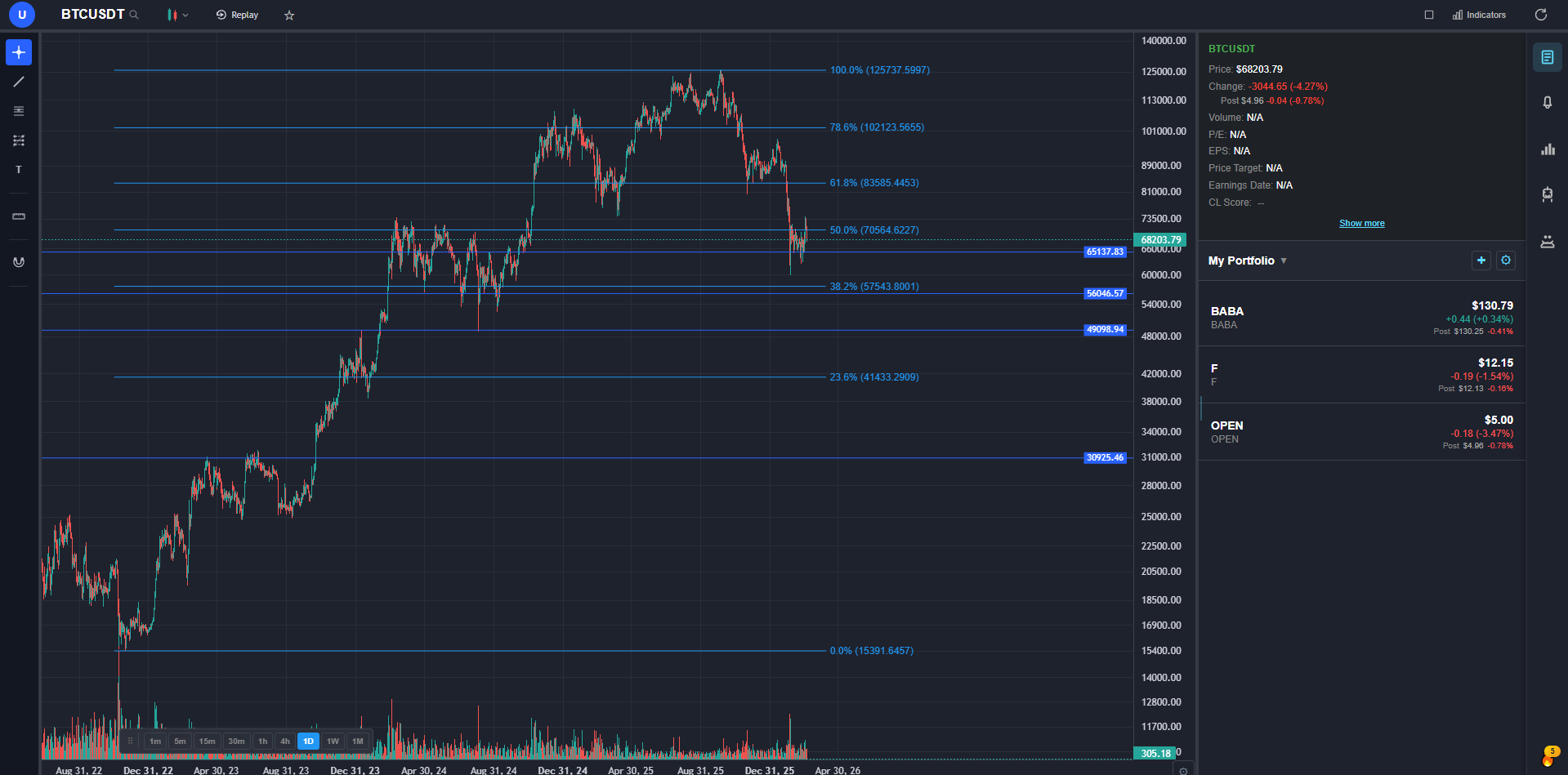
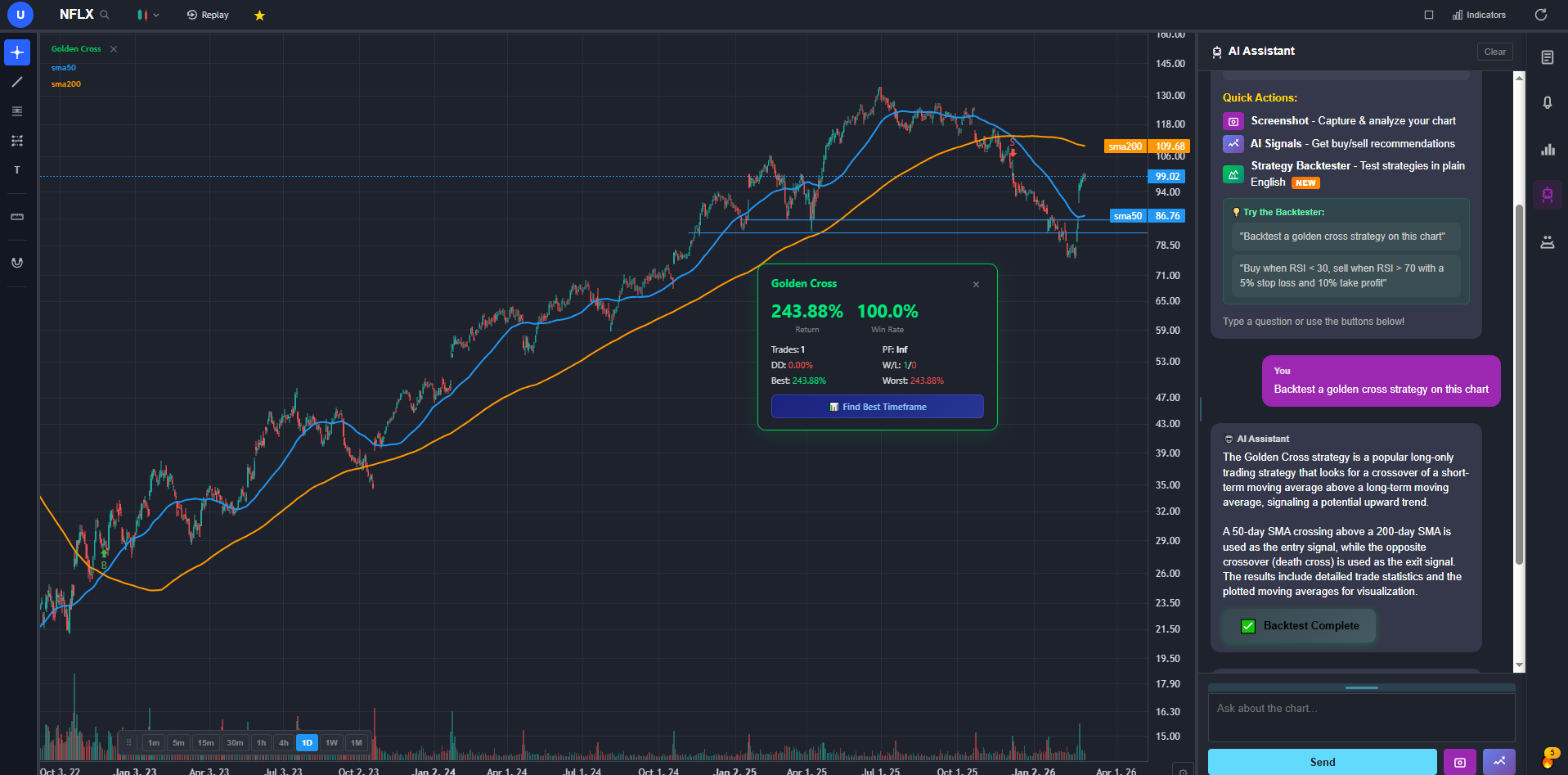
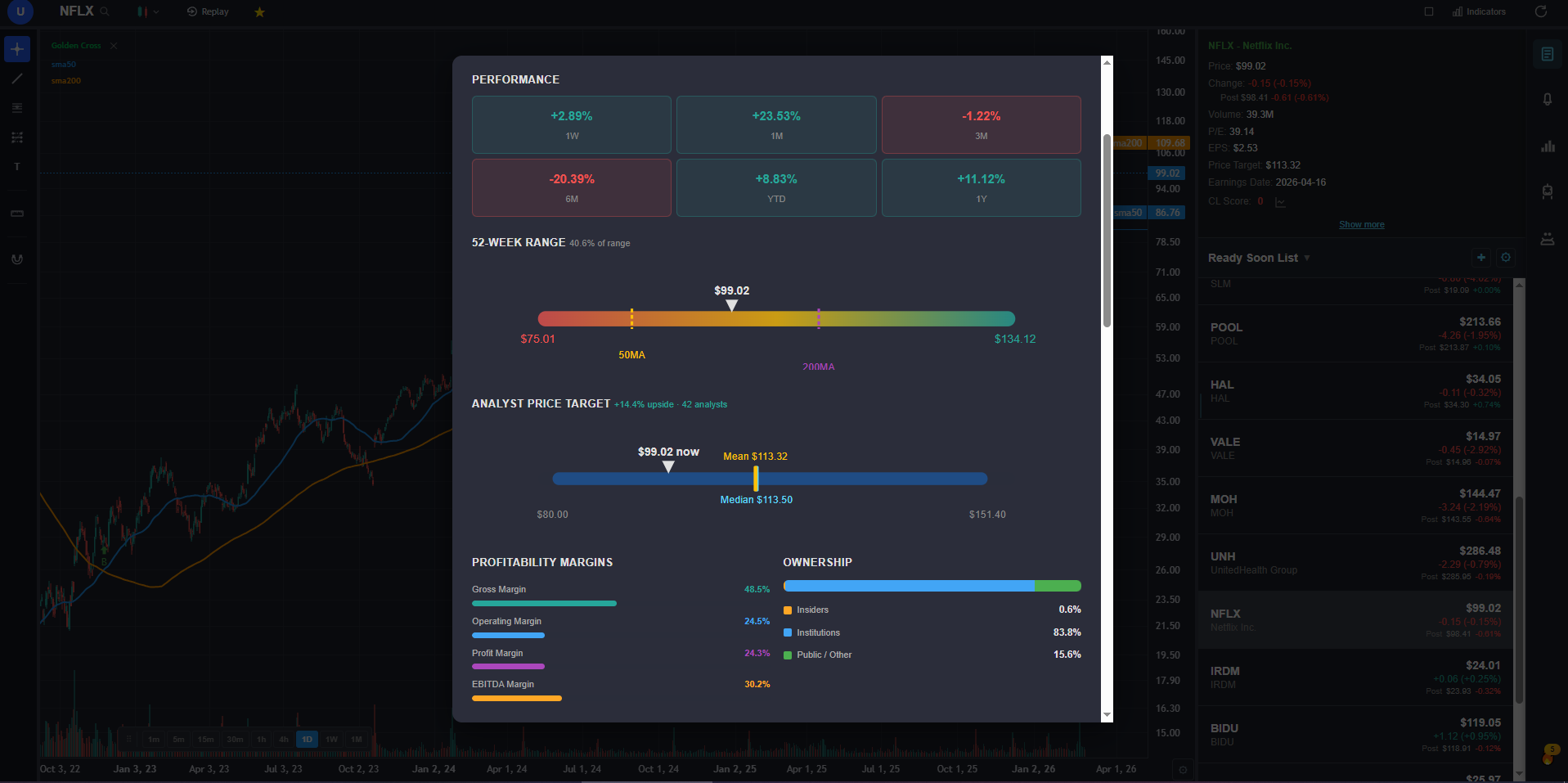
ChartingLens is purpose-built for the swing trading workflow. Daily and 4-hour charts load with 15+ indicators available at no extra cost — you can stack RSI, MACD, Bollinger Bands, moving averages, and volume on the same chart without hitting a paywall. That alone puts it ahead of platforms that gate multi-indicator views behind premium tiers.
The alert system is where it really stands out for swing traders. You can set price alerts at key support and resistance levels, indicator alerts when RSI or MACD hits a threshold on the daily chart, and trendline alerts that fire when price crosses or closes through a drawn trendline. All of these send email notifications. That means you set your levels in the evening, go about your day, and get notified when a setup is forming. No screen-watching required.
The AI signals scan on the daily timeframe, which is exactly what swing traders need. Instead of intraday noise, you get daily-resolution signals across 2,000+ stocks — flagging bullish setups that align with multi-day holding periods. The plain-English backtester lets you test swing strategies like "buy when RSI drops below 30 and MACD crosses bullish, sell when RSI rises above 70" without writing a single line of code. Then convert any backtest into a live strategy alert that runs automatically.
Insider cluster detection is a genuinely useful catalyst filter for swing traders — when multiple insiders are buying a stock around the same time, it often precedes a multi-day move. All of this for $9.99/mo, or free to start.
2. TradingView — Best for Community and Indicator Ecosystem
TradingView is the standard for charting, and for good reason. The chart engine is fast, the indicator library is massive, and the Pine Script community has built thousands of custom scripts for every swing trading strategy imaginable. If you want an indicator for "Bollinger Band squeeze with RSI divergence on the daily chart," someone has probably already published it.
The problem for swing traders is the pricing model. The free tier limits you to one indicator per chart, which is unusable for serious analysis. Email alerts — arguably the most important feature for swing traders who are not watching screens all day — require at least the Premium plan at $14.95/month. If you want more than five indicators per chart and full screener access, you are looking at Premium+ at $29.95/month. There are no native AI signals at any tier.
If you are already deep in the Pine Script ecosystem or rely heavily on community-published indicators, TradingView remains the right choice. But if you are starting fresh and want the best platform for swing trading without piecing together expensive tiers, it is no longer the automatic answer.
3. TrendSpider — Best for Automated Multi-Timeframe Analysis
TrendSpider's multi-timeframe analysis is genuinely useful for swing trading. You can see daily and 4H conditions simultaneously — for example, confirming that a daily support level aligns with 4H RSI being oversold. The auto trendline detection saves real time when scanning charts. Instead of manually drawing trendlines across twenty stocks in your watchlist, TrendSpider identifies them automatically and can alert you when price approaches them.
The downside is cost. Starting at $39/month with no free tier, TrendSpider is a significant expense for swing traders who may be placing three to five trades per week. The visual backtester is solid. If automated chart analysis is your top priority and budget is not a concern, TrendSpider delivers. Otherwise, the price is hard to justify.
4. TC2000 — Best Screener for US Equity Swing Traders
TC2000's EasyScan is one of the fastest swing trading screeners available. You build scan conditions using a formula-based interface — things like "close above 200-day SMA and RSI(14) below 35 and average volume above 500k" — and results populate almost instantly. Charts are clean and responsive. If your swing trading process starts with scanning for candidates and then charting them, TC2000 does that loop well.
Limitations for swing traders: the Silver tier ($14.99/mo) only gives you delayed scanning and limited indicator conditions. Real-time scanning with the full formula library requires Gold at $29.99/month. There is no backtesting, no AI signals, and the platform covers US stocks only — no crypto, forex, or international markets. If you are scanning US equities and nothing else, TC2000 is solid. If you need a complete swing trading tools and software solution, you will need to supplement it.
5. Finviz — Best Fundamental + Technical Screener
Finviz has the best screener for finding swing trade candidates when you want to combine fundamental filters with basic technical conditions. You can filter for stocks with positive earnings growth, low P/E, RSI below 30, and price above the 200-day SMA — all in one scan. The heat maps give you a quick visual read on sector momentum. For the initial step of "which stocks should I even be looking at," Finviz is hard to beat.
The problem is everything after the scan. Finviz charts are static images — you cannot draw trendlines, add indicators interactively, or set alerts. Real-time data requires Elite at $39.50/month. There is no backtesting and no AI signals. Finviz is a screener, not a charting platform. Most swing traders who use Finviz pair it with another tool for actual chart analysis and trade management. That two-tool workflow works, but it means paying for and managing two platforms.
6. Trade Ideas — Most Powerful Scanner (But Overkill for Swing)
Trade Ideas has one of the most powerful market scanners in the industry. Holly AI generates trade ideas based on real-time pattern recognition and backtested historical setups. The scanner is deeply configurable — you can build alert windows for almost any technical condition across thousands of stocks simultaneously. For active traders who need a swing trade scanner with alerts, the raw capability is impressive.
The issue for swing traders specifically: Holly is optimized for intraday opportunities, not multi-day swing setups. Most of the AI-generated ideas are short-duration trades. At $118/month for Standard and $228/month for Premium, the cost is extremely difficult to justify when you are making a handful of trades per week. Trade Ideas makes sense if you also day trade actively and can spread the cost across a high trade volume. For dedicated swing trading, it is overkill in both complexity and price.
7. Webull — Best Free Option for Beginners
Webull is free with commission-free trading, and you can chart and execute trades in the same app. For a beginner swing trading a small account, that is a real advantage — no monthly subscription eating into returns before you even make a trade. The mobile app is polished, and basic charting covers daily candles with a handful of indicators.
The limitations become clear quickly. Charting is basic — limited indicators, no multi-chart layouts, no trendline alerts. There is no backtesting, no AI signals, and no real screener for technical swing setups. Price alerts exist but indicator-based alerts do not. Webull is fine for getting started, but most swing traders outgrow it within a few months and move to a dedicated analysis platform. You can always keep Webull for execution and use a separate tool for analysis.
The Swing Trading Toolkit for Under $10/mo
One of the most common questions I get is how much swing traders should actually spend on tools. Here is the honest math.
If you tried to build a complete swing trading workflow by piecing together specialized tools, you would need at minimum:
- TradingView Premium for email alerts and multi-indicator charts — $14.95/month
- Finviz Elite for real-time screening — $39.50/month
- A backtesting tool (many start at $20–$50/month)
That is roughly $75–$105/month across three different platforms, each with its own login, its own interface, and its own learning curve. You are paying for overlap — all three have charts, but only one has good charts. All three show prices, but you are only screening in one of them.
The #1 pick above consolidates that into a single platform at $9.99/mo. You get the alerts (price, indicator, and trendline with email), the screener, the plain-English backtester, AI signals on daily timeframes, insider data, and 15+ indicators with no per-chart cap. One platform instead of three, at roughly one-fifth the combined cost.
For swing traders specifically, this matters because your trade frequency does not justify expensive tooling. If you are placing three to five trades per week, a $100/month tool stack needs to generate an extra $1,200/year just to break even on the software. At $9.99/mo, the breakeven threshold is $120/year — roughly one good trade. That is the difference between an affordable trading platform that fits the swing trading model and enterprise-grade tools designed for full-time day traders.
My Final Verdict
The #1 pick above is purpose-built for the swing trading workflow at a price point that makes sense for the trade frequency. Daily and 4H charts with unlimited indicators, a triple-layer alert system with email delivery, AI signals that scan on the daily timeframe, a plain-English backtester, and insider cluster detection — all in one platform. For swing traders, that combination is hard to beat.
TradingView is the safe, established choice if you want community-published Pine Script strategies and the largest indicator ecosystem. Just know that you are paying $14.95–$29.95/month to get the features swing traders actually need (email alerts and multi-indicator charts), and you still will not have AI signals or no-code backtesting.
Everything else falls into one of two buckets: too expensive for swing trading (TrendSpider at $39+/month, Trade Ideas at $118+/month) or too limited for serious analysis (Webull's basic charts, Finviz's static charts). TC2000 is a solid middle ground for US equity scanning, but it does not cover backtesting or AI, so you end up supplementing it anyway.
Frequently Asked Questions
Related Reading
- Best Stock Screeners in 2026: 7 Ranked - seven screeners tested on the same scans.
- Best Free Stock Charting Software in 2026 - what free tiers actually include.