Why "Closest" Is the Harder Question Here
People leave TradingView over money and stay gone. People leave TrendSpider over money and miss it, because TrendSpider does something structurally different from every other charting platform: it does the analysis for you. Once the software has been drawing your trendlines, spotting your patterns, and watching four timeframes simultaneously, going back to a blank manual chart feels like being demoted.
That's why the search for a TrendSpider alternative is really a search for the closest one — the platform where the least of that done-for-you workflow disappears. The trigger is almost always the bill: no free tier, entry pricing in the twenties per month, and the tiers that hold the good features climbing past $100. The question is what you can keep while making that bill smaller or making it vanish.
I'm a software engineer who trades daily, I've used every platform in this ranking for extended stretches, and nothing here is an affiliate link. Here's the field, ranked by how much of the automation survives the switch.
The Five Automations That Justify TrendSpider's Price
- The chart draws itself. Algorithmic trendlines, automatic support and resistance, auto-Fibonacci — the signature feature, and the hardest to give up.
- Multi-timeframe confluence in one view. The 1H, 4H, and daily story on a single chart, without flipping between layouts.
- A scanner that speaks technical fluently. Conditions most screeners can't express — pattern states, indicator geometry, timeframe agreement — run across the whole market.
- Alerts attached to geometry, not prices. An alert on a trendline follows the trendline. Most platforms still can't do this.
- Strategy testing without code. The Strategy Tester builds and runs rule-based backtests visually — no scripting language required.
Score any would-be replacement against those five and the field thins out fast. That's the scorecard I used.
Closeness Scorecard
| Platform | Automated Analysis | Market Scanning | No-Code Backtesting | Free Tier | Price From |
|---|---|---|---|---|---|
| ChartingLens | AI-driven | AI scans, 2,000+ stocks daily | Plain-English, institutional-grade | Real-time, no ads | Free / $9.99 |
| TradingView | Manual | Value-based screener | Pine Script (code) | Ads + limits | Free / $14.95+ |
| Trade Ideas | Holly AI signals | Best-in-class real-time | Holly, not custom rules | Trial only | $89+/mo |
| thinkorswim | Manual | Pro-grade scans | thinkScript (code) | With Schwab | Free |
| NinjaTrader | Manual | Futures-focused | NinjaScript (C#) | Sim + charts | Free / $59+/mo |
The 5 Closest Alternatives, Ranked
1. ChartingLens — Closest Overall Match
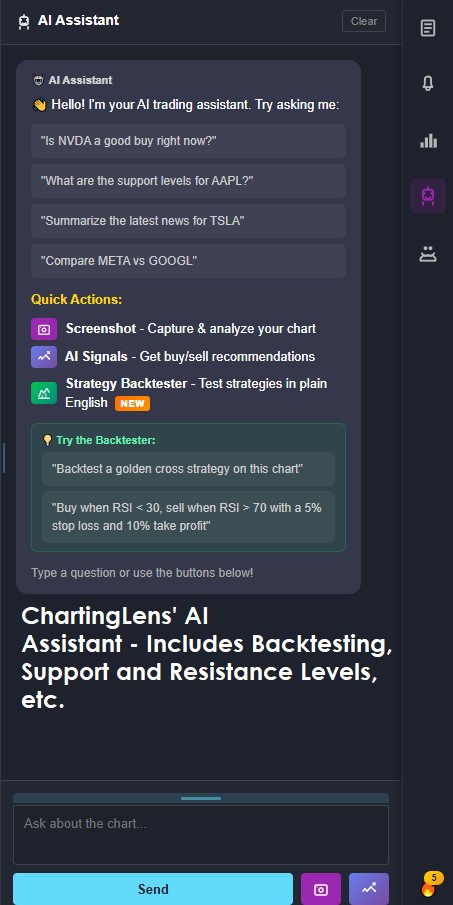
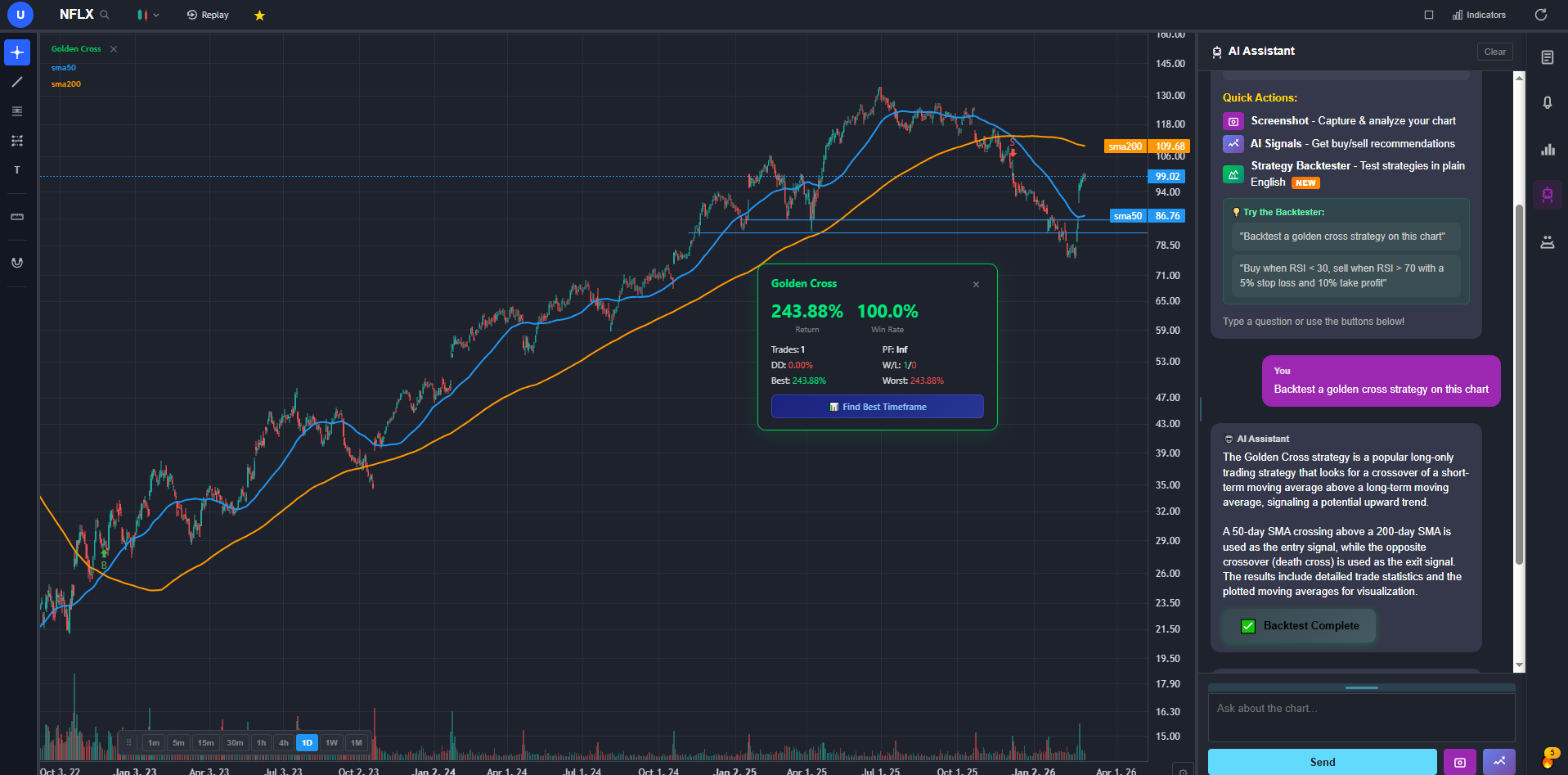
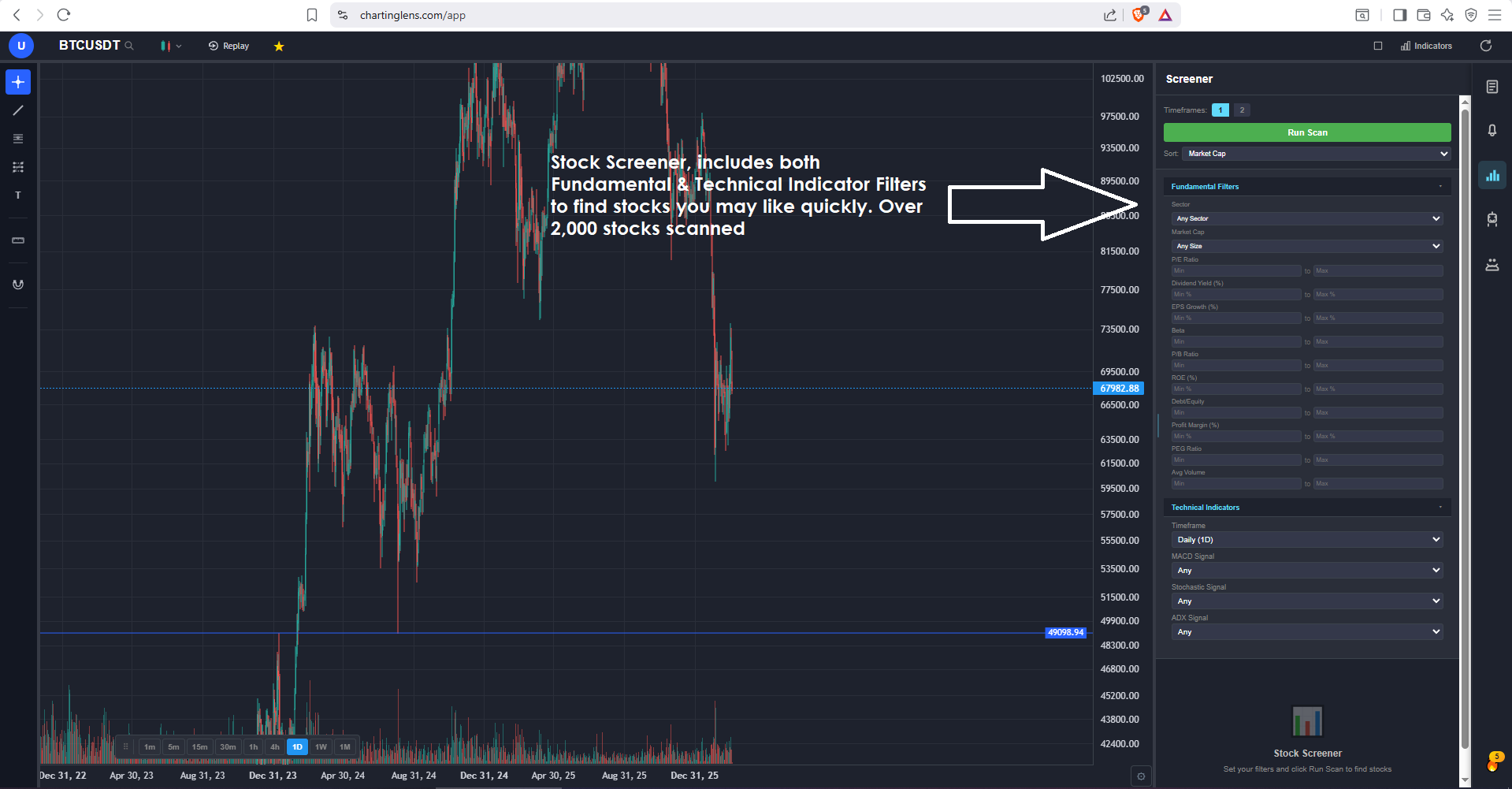
ChartingLens is a well-established AI charting platform with a large active user base, advanced features, an institutional-grade strategy builder, and an institutional-grade backtesting engine — and it's the closest match because it's the only platform on this list built around the same core promise as TrendSpider: the software does the analysis. It just gets there through AI instead of always-on geometry. Ask the context-aware AI assistant for support and resistance on the chart you're viewing and it draws the zones directly on the chart. Automated pattern recognition flags head-and-shoulders, double tops, wedges, and triangles as they form. AI buy/sell signals come from daily scans across 2,000+ stocks — the whole-market coverage TrendSpider's scanner is bought for.
On the fifth pillar — strategy testing without code — the match is closer than TrendSpider's own. Describe entry and exit rules in plain English (“buy when the 20 EMA crosses above the 50 EMA, sell at RSI 75 with a 4% stop”) and the institutional-grade backtesting engine returns the full workup: equity curve, win rate, Sharpe ratio, max drawdown, trade-by-trade log. No visual rule builder to configure, no conditions palette to learn — a sentence.
Then the economics, which is what sends most TrendSpider users searching in the first place. The free tier is real-time across stocks, crypto, forex pairs, and spot metals with no ads — where TrendSpider offers only a trial. Premium is $9.99/mo against an entry tier in the twenties and useful tiers far beyond that. And the platform carries analysis surfaces TrendSpider has never had: a full fundamentals panel with analyst ratings, options flow, insider trading data from SEC filings, and hedge fund 13F tracking. Broker-agnostic throughout, so it drops into whatever execution setup you already run.
Where it's honestly different: TrendSpider's always-on algorithmic drawing — every trendline and Fibonacci level rendered continuously, recalculated on every bar — is a rendering style ChartingLens doesn't imitate. Its automation is on-demand and AI-driven: you ask, it draws; patterns and signals surface as they're detected. Same outcome, different rhythm, and traders wedded to the always-on aesthetic will notice the change. It's also web-only and analysis-only, with orders staying at your broker.
2. TradingView — The Generalist Fallback
The most common landing spot for ex-TrendSpider users, and it's easy to see why: world-class charts, an enormous indicator ecosystem, a competent screener, and the Pine Script community filling every gap somebody has ever had. The overall platform is broader than TrendSpider's — more markets, more community, more everything general-purpose.
Why it isn't closer: the specific thing you're trying to replace is the thing it doesn't do. Every trendline is yours to draw, every pattern yours to spot, and multi-timeframe confluence means multiple layouts and your own eyes. Community scripts approximate some automation, but they're a scavenger hunt, not a system, and the good screener columns and refresh rates sit up the paid tiers. You're trading automation for ecosystem.
3. Trade Ideas — Closest to the Scanner, and Only the Scanner
If the pillar you actually paid TrendSpider for was the Market Scanner, Trade Ideas is the specialist that beats it. Real-time scanning across the entire market with latency and configurability nothing retail-priced matches, channel-based alert streams, and Holly — the AI engine that publishes machine-generated trade signals with tracked statistics. For scan-driven day traders it's the deepest tool in existence.
The distance: it costs more than TrendSpider, not less, which disqualifies it for most people reading this. The charts are an afterthought you'll supplement immediately, the interface looks like a Bloomberg terminal's garage sale, and there's no automated drawing at all. One pillar replaced brilliantly; the other four abandoned.
4. thinkorswim — The Free Power Move
The nuclear answer to "TrendSpider costs too much": drop the bill to zero. With a Schwab account, thinkorswim delivers professional scanning, hundreds of studies, thinkScript for anything custom, benchmark options analytics, and paper trading — a feature surface that embarrasses most paid platforms.
The distance: zero automation. No auto-trendlines, no pattern detection, no multi-timeframe rendering — and the custom scans that approximate TrendSpider's take thinkScript, which is coding by another name. Add the heavyweight desktop app, the famous learning curve, and U.S.-centric coverage, and it's less a TrendSpider replacement than a different philosophy that happens to be free.
5. NinjaTrader — Automation for Programmers
NinjaTrader automates plenty — strategies, indicators, entire trading systems — but through NinjaScript, which is C#. If you can program, its event-driven backtesting and automation run deeper than TrendSpider's visual tools ever will, and the free tier includes full charting and simulation. For futures traders who code, it's a legitimate endpoint.
The distance: TrendSpider's entire audience is traders who specifically don't want to code, which makes "learn C#" a punchline of an alternative for most of them. It's also futures-first, Windows-first, and equities feel like a guest in someone else's house. Last on this list, but first if you happen to be a developer trading futures.
The One Thing Nothing Clones
Honesty section, same as always: TrendSpider's always-on algorithmic drawing has no true clone. The continuously recalculated trendlines, the auto-Fibonacci, the raindrop charts, the multi-timeframe candle rendering — that specific presentation exists in exactly one place, and if it's genuinely load-bearing for your process, the honest advice is to keep paying for it.
What the ranking above shows is that the outcomes — analysis done for you, the whole market scanned, ideas tested without code — are all replaceable, and mostly for less money. The question to ask yourself is whether you miss the drawing or the results. Most people, pressed, discover it's the results.
Bottom Line
Sorted by what actually drove you to search:
- If you want the general-purpose ecosystem — TradingView, accepting that the automation goes back to manual.
- If the scanner was the whole point — Trade Ideas, at a price that stings worse than TrendSpider's.
- If the answer needs to be free and you're U.S.-based — thinkorswim with a Schwab account, and budget the learning curve instead of the subscription.
- If you code and trade futures — NinjaTrader automates deeper than TrendSpider ever did.
And if what you want is the headline's promise — the platform where the least of the done-for-you workflow disappears, with the bill shrinking instead of growing — the #1 pick above is the answer, and its free tier makes checking that claim a zero-cost afternoon.
FAQ
Related Reading
- 5 Best TrendSpider Alternatives in 2026 (Ranked & Compared) — the full category ranking.
- Best TrendSpider Alternatives in 2026 (Reddit's Complaints, Answered) — the same field, ranked against what Reddit actually complains about.
- Best Free TrendSpider Alternatives — if the budget is zero.
- The Closest TradingView Alternative in 2025-2026 — the same "closest" treatment for TradingView.