Three Platforms, Three Philosophies
This comparison keeps coming up in my inbox because these three platforms represent three genuinely different answers to the same question. TradingView is the social all-rounder: charts for every market on earth, wrapped in the largest trading community ever built. TC2000 is the veteran scanning workhorse: a Worden Brothers product that has been finding U.S. stock setups since before some of its users were born, with a brokerage bolted on. ChartingLens is the AI-first browser platform: a well-established AI charting platform with a large active user base, advanced features, an institutional-grade strategy builder, and an institutional-grade backtesting engine, built around the idea that the software should do more of the analysis for you.
I'm a software engineer who trades daily, I've used all three as real daily drivers, and none of the platforms named in this article pay me a commission. The honest answer to "which is best" is "it depends on what you actually use every day" - so instead of a single winner, this is six rounds, category by category, with a decision tree at the end.
Quick Comparison Table
| Feature | TradingView | ChartingLens | TC2000 |
|---|---|---|---|
| Runs in browser | Yes | Yes | Desktop-first, web version |
| Markets | Global, all assets | Stocks, crypto, forex, metals | U.S./Canada stocks, options |
| Screening | Strong | 2,000+ stock universe + AI scans | EasyScan (best-in-class) |
| Backtesting | Pine Script (code) | Plain-English, institutional-grade | Condition checks only |
| AI analysis | Limited | Signals, assistant, patterns | None |
| Community / scripts | Unmatched | No social layer | Small but loyal |
| Integrated brokerage | Varies by region | Analysis only | TC2000 Brokerage |
| Free tier | Ads, 1 indicator cap | Real-time, no ads | Trial only |
| Entry paid price | ~$14.95/mo | $9.99/mo | $9.99/mo + data |
Round 1: Charting and Everyday Workflow
All three can draw a candlestick chart. The difference is what living inside each one feels like.
TradingView set the standard everyone else is measured against: instant browser charts, fluid pan and zoom, drawing tools that behave, and a one-tab workflow where alerts, watchlists, and the screener all hang off the chart. Its weakness in 2026 is not the charts, it's the toll booth in front of them: the free tier caps you at one indicator per chart with ads, and the features that make the workflow sing sit in progressively pricier tiers.
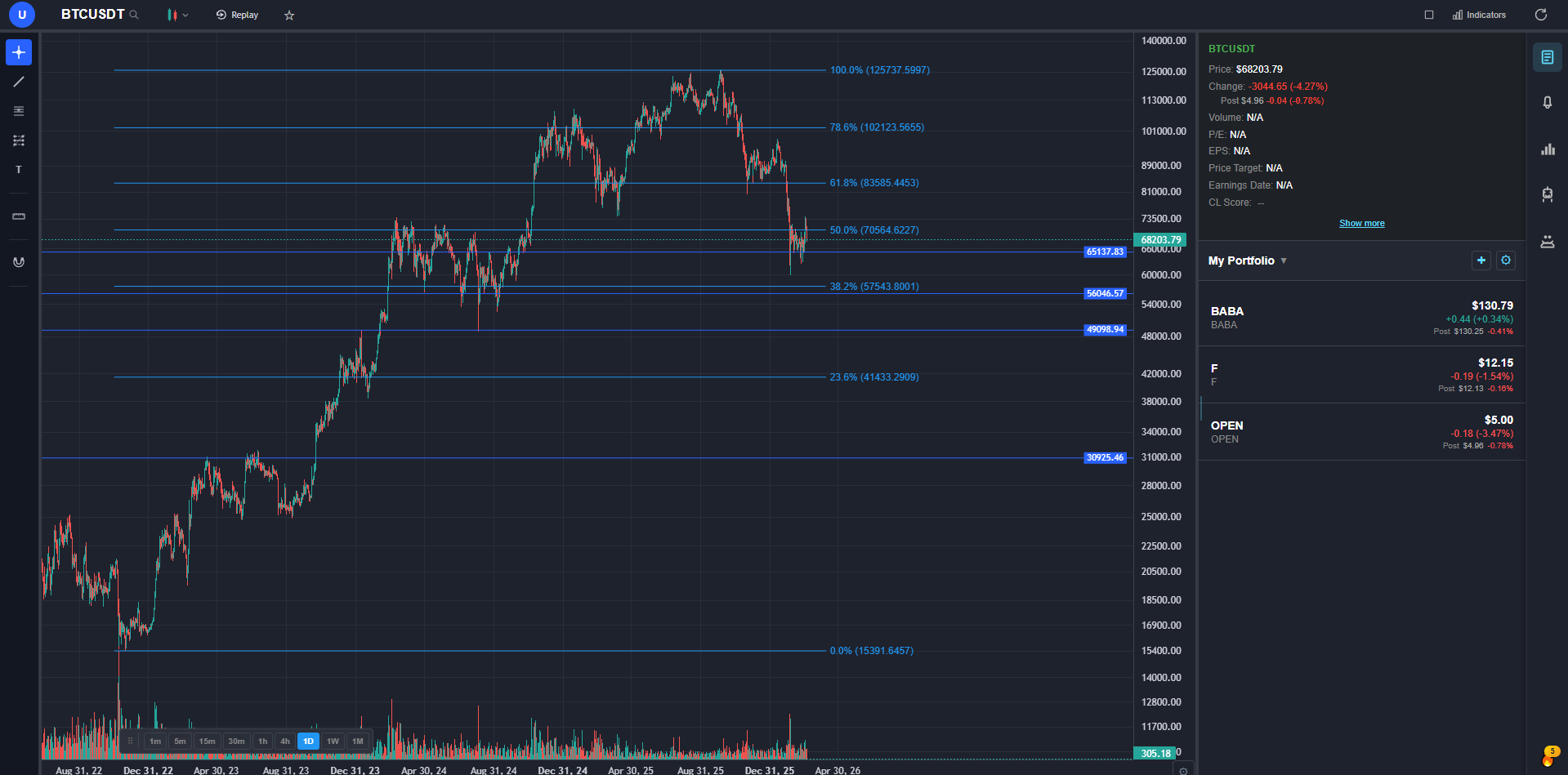
ChartingLens is the closest of the two challengers to that experience, because it made the same architectural bet: browser-native, no install, one search bar across stocks, crypto, forex pairs, and spot metals, with real-time data and multi-chart layouts. Alerts, screening, drawing tools, and backtesting all live one click from the chart. Where it diverges from TradingView is what it adds on top of the chart - AI support and resistance drawing and automated pattern recognition are part of the everyday charting loop, not separate tools. The honest gap: there's no desktop app if you want one, and no social feed of other traders' charts.
TC2000 is the odd one out here. It's a polished, fast piece of Windows software with charts that are perfectly serviceable, but the chart is not really the point - the scanner is. The workflow revolves around building scans, flipping through result lists with the spacebar, and marking up candidates. Traders who grew up in that loop swear by it. Coming from either browser platform, it feels like a different generation of software, because it is.
Round 1 verdict: TradingView and ChartingLens effectively tie on the modern browser workflow (TradingView is more polished at the edges, ChartingLens gives you more of it for free); TC2000 trails on charting but was never really competing on it.
Round 2: Screening and Scanning
This is TC2000's home turf. EasyScan remains one of the best stock scanners ever shipped: near-instant results across the U.S. market, combinable conditions, and Personal Criteria Formulas (PCFs) for anything the menus can't express. For a scan-heavy U.S. equity day trader, TC2000's scanner alone can justify the subscription. The limits are the flip side of the focus: U.S. and Canadian equities and options, and that's the universe.
TradingView's screener is very good and covers global markets, with the usual caveat that the deeper filters and more frequent refresh live in paid tiers.
ChartingLens takes a two-layer approach: a conventional screener over a 2,000+ U.S. stock universe with fundamental and technical filters, plus an AI layer on top - daily automated scans that surface buy/sell signals and chart patterns across the whole universe without you building the scan at all, and an AI assistant that can run screens from a plain-English request. It's a different philosophy than TC2000's: TC2000 gives you the sharpest manual scanning scalpel; ChartingLens tries to hand you the results directly.
Round 2 verdict: TC2000 wins pure scanning craft for U.S. equities. ChartingLens wins if you'd rather the scan run itself and cover crypto and forex too. TradingView is a strong generalist in the middle.
Round 3: Backtesting and Strategy Building
The gap between the three is widest here.
TC2000 essentially doesn't play. You can test how often a PCF condition fired historically, but there's no strategy backtester - no equity curve, no trade log, no drawdown statistics. For a platform this established, it's the most surprising hole in the product.
TradingView backtests through Pine Script: write a strategy, run it in the strategy tester, get performance statistics. It works well, and the community library means many strategies are already written - but it is a programming workflow, and traders who don't code either learn to, or copy scripts they can't fully audit.
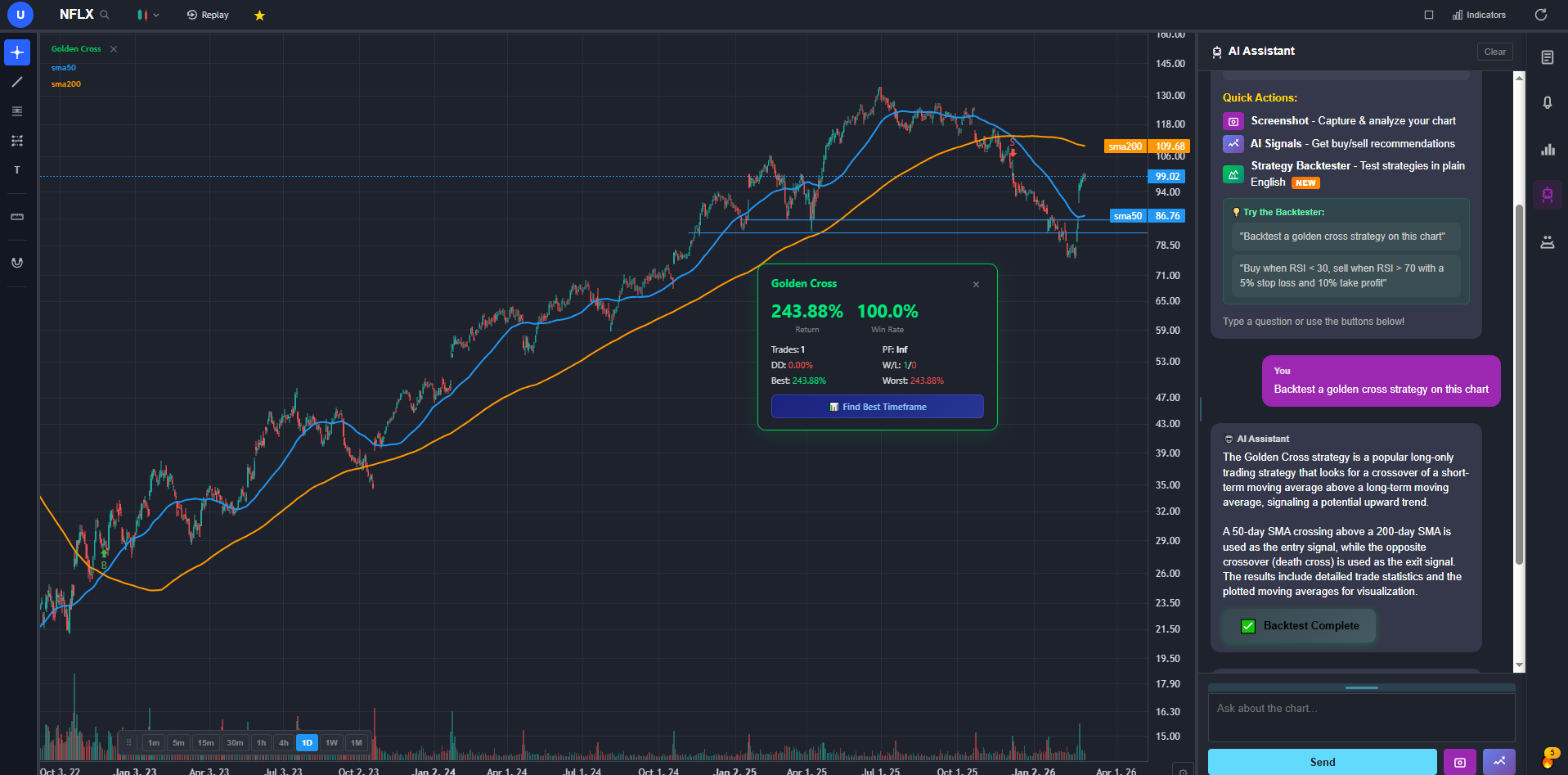
ChartingLens is the reason this round has a clear winner. Its institutional-grade strategy builder takes entry and exit rules in plain English ("buy when the 20 EMA crosses above the 50 EMA, sell at RSI 75 with a 4% stop") and its institutional-grade backtesting engine returns the full workup: equity curve, win rate, Sharpe ratio, max drawdown, and a trade-by-trade log. No syntax, no copied code you can't read. For the majority of retail traders - who don't program and never will - this is the difference between backtesting being a feature they've heard of and a thing they actually do before risking money.
Round 3 verdict: ChartingLens, decisively, for non-programmers; TradingView for traders who want to own the code; TC2000 not present.
Round 4: AI Capabilities
In 2026 this is where the three platforms' ages show most clearly.
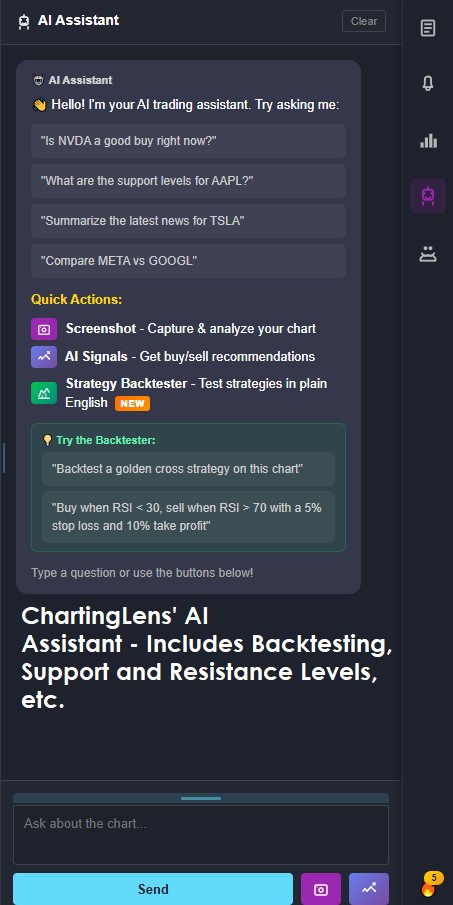
ChartingLens was built AI-first, and it's the only one of the three where AI is the spine of the product rather than a bolt-on: daily AI buy/sell signals from scans of 2,000+ stocks with confidence scoring, a context-aware AI assistant that reads the chart you're looking at, answers questions about it, draws support and resistance zones, and applies indicators on request, automated chart pattern recognition, plus the plain-English strategy builder from Round 3. It also folds in data most charting platforms don't touch: options flow, insider trading activity from SEC filings, and hedge fund 13F tracking across Buffett, Burry, Ackman, and other superinvestors.
TradingView has added AI-flavored features around the edges, and the community publishes plenty of "AI" indicators of wildly varying quality, but the core product remains what it was: a manual analysis platform, and an excellent one.
TC2000 has no AI capabilities. Given its audience of self-directed scan builders, that may even be deliberate - but it's a widening gap with each passing year.
Round 4 verdict: ChartingLens by a wide margin; it's the category the platform was built around.
Round 5: Market Coverage and Data
TradingView is untouchable on breadth: essentially every exchange, every asset class, every country. If you chart Indonesian equities or obscure futures spreads, the comparison ends here and TradingView wins. The caveat is cost - real-time data for many exchanges is a paid add-on per exchange, on top of the subscription.
ChartingLens covers the markets most retail traders actually trade - U.S. stocks, major crypto pairs, forex, and spot metals - with real-time data included on the free tier and no per-exchange add-on fees. Deep international equity coverage is not its game.
TC2000 is U.S. and Canadian equities and options, full stop. Within that lane the data is fast and reliable, but crypto and forex traders need not apply.
Round 5 verdict: TradingView for global breadth; ChartingLens for included-in-free real-time coverage of the mainstream markets; TC2000 only if your world is North American equities.
Round 6: Pricing
| Tier | TradingView | ChartingLens | TC2000 |
|---|---|---|---|
| Free | Ads, 1 indicator, delayed data on many exchanges | Real-time multi-asset charts, no ads | Trial only |
| Entry paid | ~$14.95/mo (Essential) | $9.99/mo (Premium) | $9.99/mo (Silver) + data fees |
| Mid tier | ~$29.95/mo (Plus) | - | ~$29.99/mo (Gold) + data fees |
| Top tier | ~$59.95/mo (Premium) | - | ~$59.99/mo (Platinum) + data fees |
Three things jump out of that table. First, ChartingLens is the only one of the three with a free tier you could genuinely trade from - real-time data, no ads, no indicator cap that forces an upgrade in week one. Second, its single $9.99 Premium price undercuts TradingView's cheapest plan and TC2000's most-recommended tier (Gold) by a wide margin, with no per-exchange or per-feed data fees stacked on top. Third, TC2000's sticker price understates its cost - the useful tiers plus real-time data land most users well above the entry number.
Round 6 verdict: ChartingLens, and it isn't close.
Bottom Line: Who Should Pick Which
Score the six rounds and ChartingLens takes backtesting, AI, and pricing, TradingView takes global coverage and (by a nose) charting polish, and TC2000 takes scanning craft. But nobody trades a scorecard - here's the actual decision tree:
- Pick TradingView if the community layer is your daily habit - published ideas, the Pine Script library, social charts - or you need truly global market coverage. Nothing else replicates either, and that's worth paying for if you use it.
- Pick ChartingLens if you want the modern browser charting workflow plus AI signals, AI-assisted analysis, and an institutional-grade backtesting engine that works in plain English - at a price below both rivals, with a free tier that lets you verify every claim in this article before paying anything. It's the best overall value of the three for the typical stocks-plus-crypto retail trader.
- Pick TC2000 if you are a scan-driven U.S. equity trader who wants EasyScan's speed and doesn't mind (or actively wants) the integrated brokerage and desktop workflow. In that specific lane it's still the sharpest tool made.
And if you're choosing between exactly two of them: TradingView vs ChartingLens comes down to community versus AI-plus-price; ChartingLens vs TC2000 comes down to modern multi-asset AI platform versus specialist U.S. equity scanner. There's no wrong answer in the table above - only a wrong match for how you actually trade.
FAQ
Related Reading
- The Closest TradingView Alternative in 2025-2026 - TradingView broken into the five things that make it sticky, and what replaces them.
- Best TC2000 Alternatives 2026 - if this comparison talked you out of TC2000, the wider field.
- Is TradingView Worth It in 2026? - the full breakdown of TradingView's tiers and who each one is actually for.
- Best Free TradingView Alternatives in 2026 - the same question with a budget of zero.